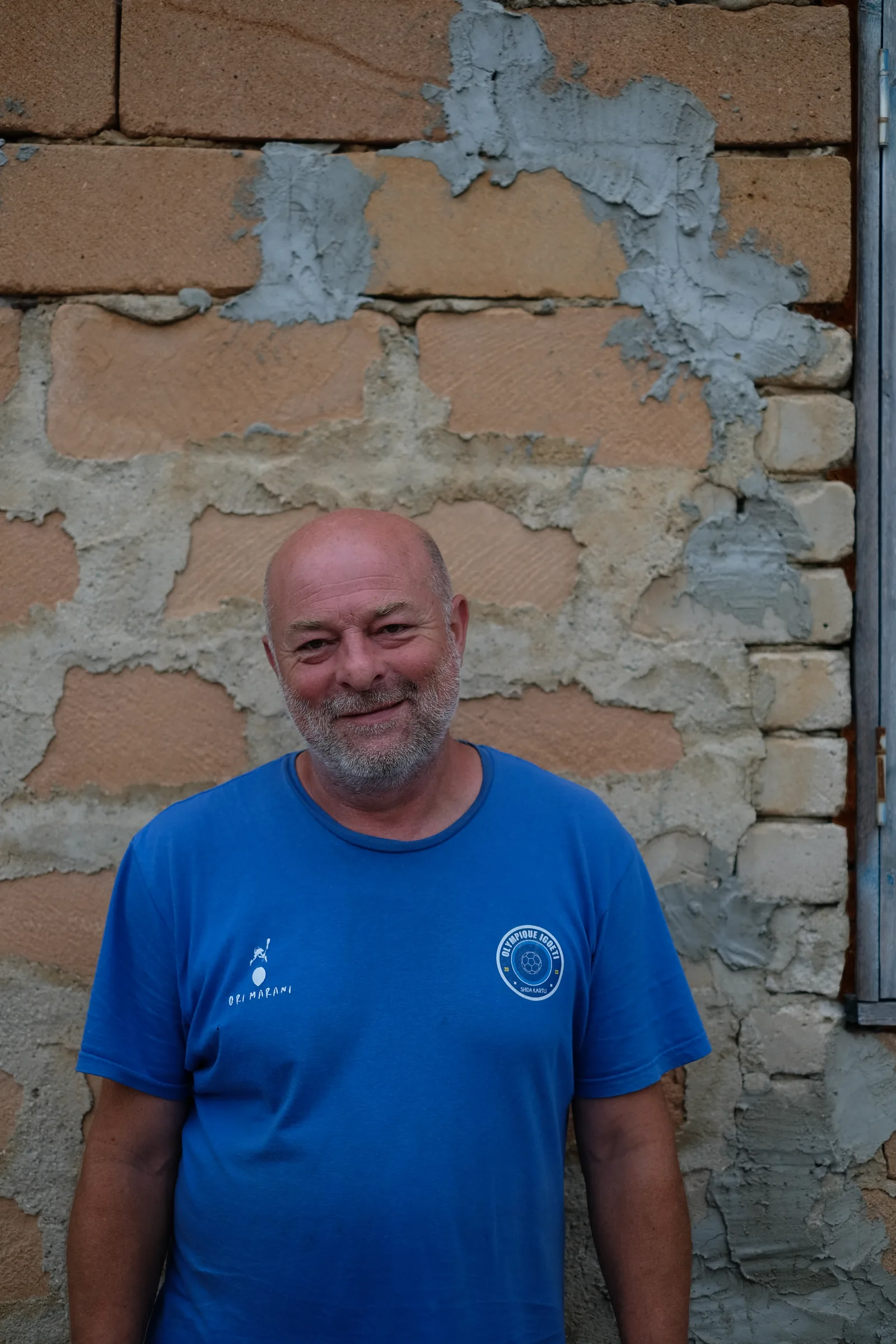
Everywhere we went afterwards, the name Ramaz Nikoladze produced the same reaction. Faces changed. People in wine spoke of him as a rock star, sometimes as the godfather of Georgian natural wine. Then they spoke about his generosity: the younger producers he had encouraged, the practical help he had given, the knowledge he had shared without guarding it.
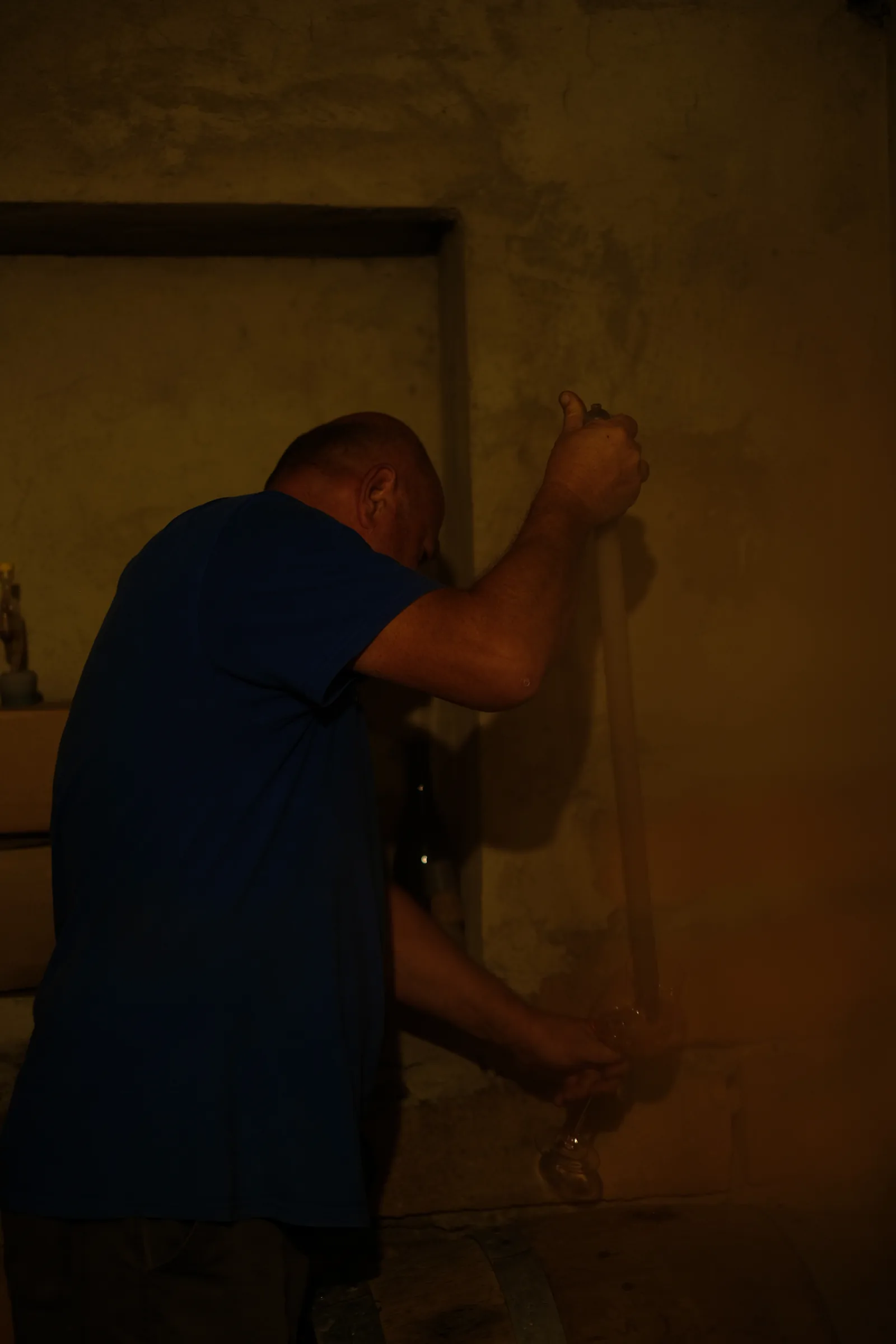
We did not yet know any of that on the afternoon of the first of August. We arrived after lunch and found Ramaz alone at the winery. He was bottling. Some of the wines we would open had gone into bottle the day before and had no labels.
Ramaz began with the yearly movement of the cellar. Fermentation and the first part of ageing take place in qvevri. When spring raises the temperature, he racks the wine into stainless steel and waits. At the end of July or during the first days of August, he bottles. We had arrived inside that short interval, with one vintage leaving the vessels and the next harvest not far away.
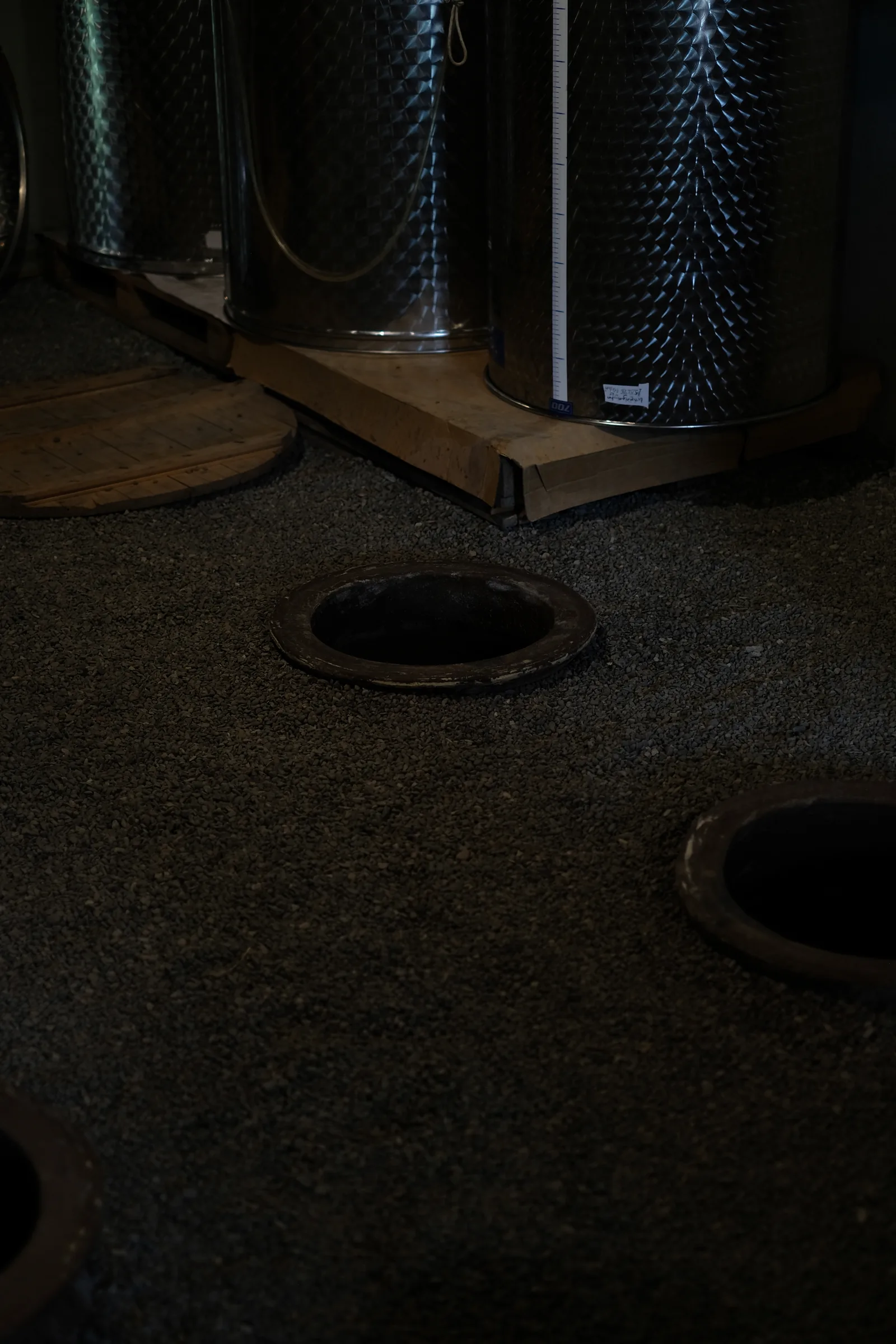
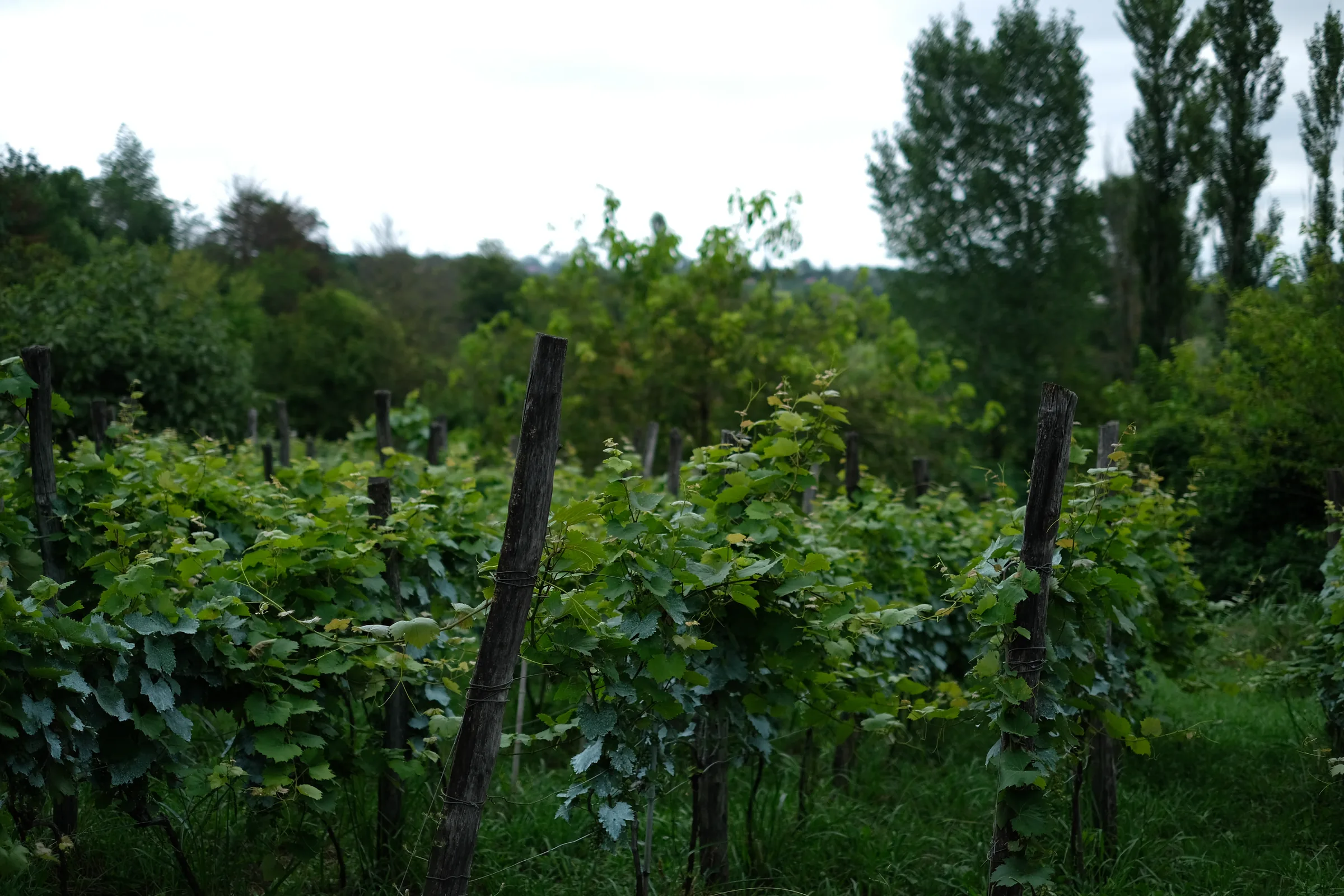
He works principally with the two white grapes in his vineyard, Tsitska and Tsolikouri. Tsitska he makes without the skins, always. Tsolikouri can go in either direction: some years without skin contact, in others the skins stay with the wine. He would not reduce that decision to a fixed recipe. It depended on the material in front of him and on how the wine developed.
We asked which one he recommended that we taste.
“They are like children,” he said. How could he say which was best?
So we tasted all of them.
The afternoon began at the tanks. The first wine had spent three or four months in clay before being racked, and was days away from leaving the cellar. Tsitska, without skins. Then Tsolikouri in both of its directions: first without skin contact, made in the same way as the Tsitska, then with. That one required a corkscrew, which produced a short detour into Portuguese: saca-rolhas, and the word rolha for cork, which Ramaz recognised immediately.
Then came a wine from Lechkhumi, the mountain region where Ramaz’s mother was born, two hours into the high mountains from Kutaisi, where only a few villages grow the grape and the quantities are small. Ramaz associated the place with some of his best memories. His mother’s father had introduced him to the culture of wine there, the supra, the toasts, when he was still a boy. He described being sent to refill the carafe from the vessel in the cellar, watching the level in the glasses so that he would not arrive empty-handed and have to answer to his mother. He remembered it vividly, with a sparkle in his eyes.
With that wine he had tried to follow the fermentation rather than decide its destination in advance. If it stopped naturally with some sugar left, he would let it become semi-sweet. If it did not, he would not force it. The explanation was typical of the afternoon: attention first, category afterwards.
In his wines there was no heavy extraction and no attempt to make the length of maceration announce itself in the glass. Ramaz described working the cap gently, by hand. Talking to the wine, in his phrase, rather than taking from it. Long skin contact is not the tradition of his region, he said. It was his decision, and he was still learning from it. “I’m trying,” he said.
By then we had tasted enough to tell him that the wines shared a profile and an energy, even when their vessels and their contact with the skins differed. Ramaz accepted the observation without claiming it as proof of anything. He had strong ideas, but almost every one arrived softened by a phrase: “in my opinion,” “I think,” “I believe.” He never pretended that the qualification made the opinion less considered. It simply left room at the table for another one.
That became clearest when the conversation turned to natural wine. Ramaz rejected the idea that wine is made entirely in the vineyard and that the person in the cellar should disappear from the account.
“The person who is doing it is very important,” he said.
Knowing when to take a wine off its skins, how to rack it and what to leave behind required judgement. When fermentation ends, the skins settle. He takes the clean wine from the top, waits again when necessary, and sends what remains to distillation. None of this made him speak as if he controlled everything. It made him responsible for paying attention. To say that the winemaker counts for nothing, he said, is a very big mistake.
Then he showed us the barrels. They had come through a French friend who had worked with him at the bar and later brought three of them, suggesting he try doing something with them. Ramaz dislikes new oak; the effect, he said, is simply too much. These were old French barrels from Burgundy, eight years old when they arrived and older now. He described the experiment as a meeting of Georgian and European forms: local grapes and cellar judgement, but a vessel that does not belong to the usual language of Imereti. In the barrel were the two white grapes together, which the region has traditionally co-fermented. Whether the result would be commercialised or remain a test was not yet settled.
He also poured a light red in which Dzelshavi was joined by a white grape. Red, he said, but not one hundred percent red. He sometimes combines wine raised in qvevri with wine from barrel. In other years he keeps the parts separate. In 2024 he blended a little. This year he had separated everything. The distinctions mattered less to him than whether the wine worked.
When we asked why he might separate varieties rather than ferment them together, his first answer was practical: a single variety can be easier for foreigners to understand. His own preference kept returning to the blend. In Imereti, wine had long been named as wine rather than as a list of grapes. He compared co-fermentation to people: mixing different parents produces the best children. But he also conceded, without much concern, that a professional might call what he does an error. It was not an argument for blending everything. It felt more as an argument against treating separation as inherently more serious.
The tasting was not organised as a presentation of a range. We moved from tank to qvevri, from newly filled bottles to old barrels, and from the current wines to things Ramaz was making as tests. The cellar had the useful disorder of somebody working through possibilities rather than displaying finished answers.
The conversation wandered just as freely. We talked about old bottles and whether wine should be kept. Ramaz had tasted a 2011 Tsitska of his own in a wine bar in France the year before and found it in excellent condition, though he insisted the question was not really about age. What determines whether a wine lasts is what you do, or refuse to do, before bottling, and how it is stored afterwards. His answer to cellaring was in any case more immediate. Why keep a wine? Perhaps you die tomorrow and somebody else comes and drinks it. He keeps some bottles, in a second cellar. With guests, friends and relatives, he admitted, keeping them is difficult.
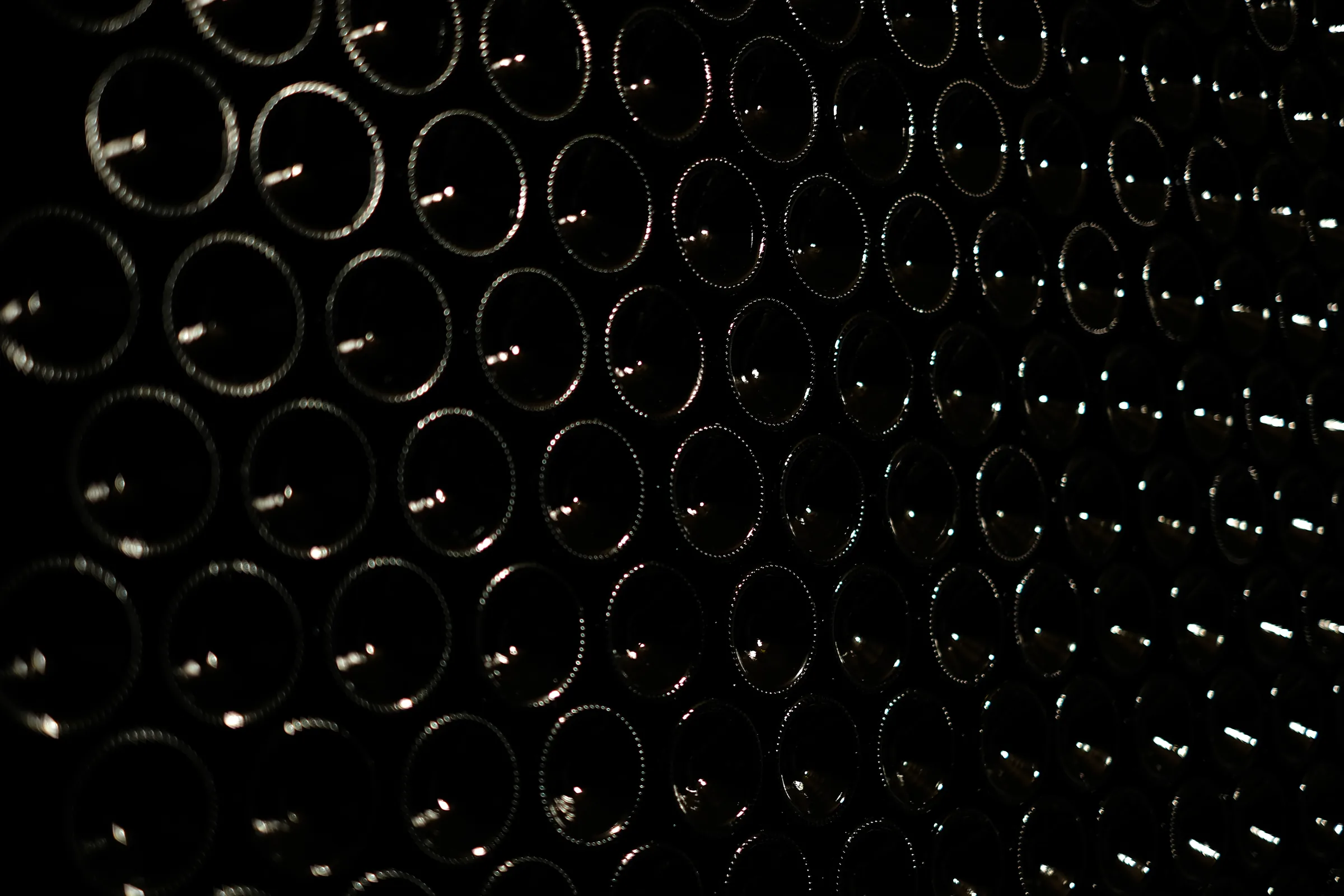
We talked about Berlin, and a long night that ended with two rejections at the door and admission at six in the morning to a club whose name he could not remember. We talked about punk and rock, about the door policies that have generated a profession of people teaching tourists how to dress. Even Elon Musk was mentioned.
And we talked about Portugal. He had been in Porto for Simplesmente Vinho in 2024 and remembered the city with obvious pleasure: the hospitality, the music, the food. Georgian friends living in Portugal had shown him where to go beyond the tourist places. Porto was all he had seen of the country. It had been enough to make him want to return.
Ramaz had been involved in Vino Underground, the first natural wine bar in Tbilisi, and described himself there as manager, director, bartender, owner. He was not sure which word covered everything. People arrived at the bar without vineyards and without experience in a cellar. Around ninety percent of those who worked there now make their own wine. Ének Peterson, whom we had visited the day before, was one of them.
This was the history behind the reaction we encountered in the following weeks. The godfather description suggested authority, but what people remembered was access. Ramaz had made himself available. He helped others begin and did not require them to repeat his conclusions.
Before leaving, we asked what we could buy. We chose the two Tsolikouri wines bottled the previous day, two bottles with skin contact and one without. There were no labels yet, so we wrote “skin” and “no skin” on pieces of adhesive paper and stuck them to the glass.
Ramaz would not let the visit end as a transaction. He asked what Portuguese people do when a guest they like is leaving the house. We had no equivalent ready: nothing beyond saying goodbye? He explained the Georgian answer: one last toast for the guest before the door, and then, if there is still something to say, a final glass at the open door for the road ahead.
We raised the glasses again. “To you and to your soul. Bon voyage.”
By the end of the trip, Ramaz’s reputation would seem almost impossibly large. The man we remembered from that afternoon kept making himself smaller inside every opinion, then filled our glasses once more before we left.