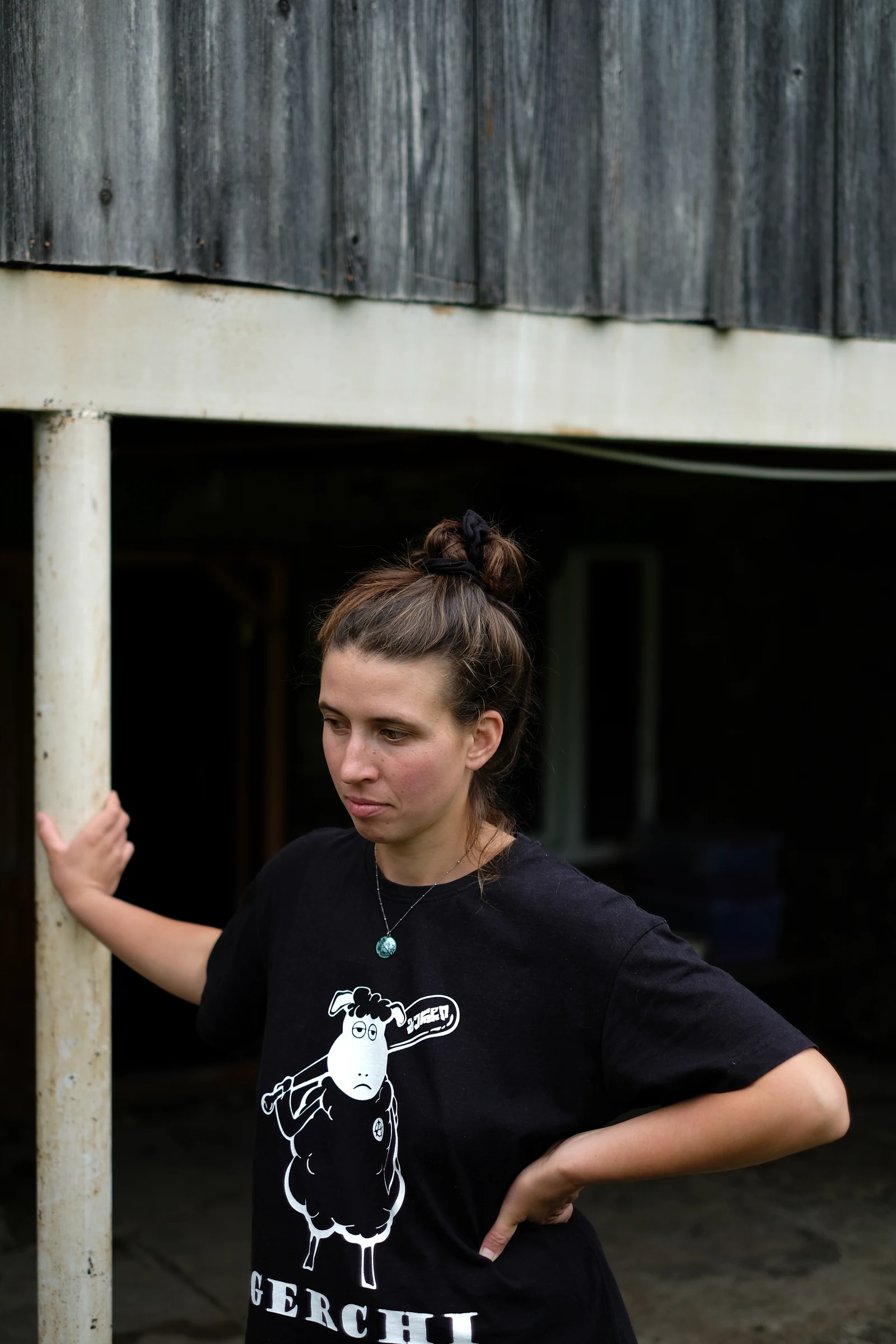
We had not slept for twenty-four hours. Porto, Zurich. A very long wait in a terminal advertising Van Eck semiconductor ETFs and private wealth management. A night flight to Tbilisi. The eight o’clock train out to Rioni, then a car from the station to Persati along roads that stop for cows. It was half past twelve on the last day of July when we reached Ének Peterson’s house, and what we wanted was a bed. We began in the cellar.
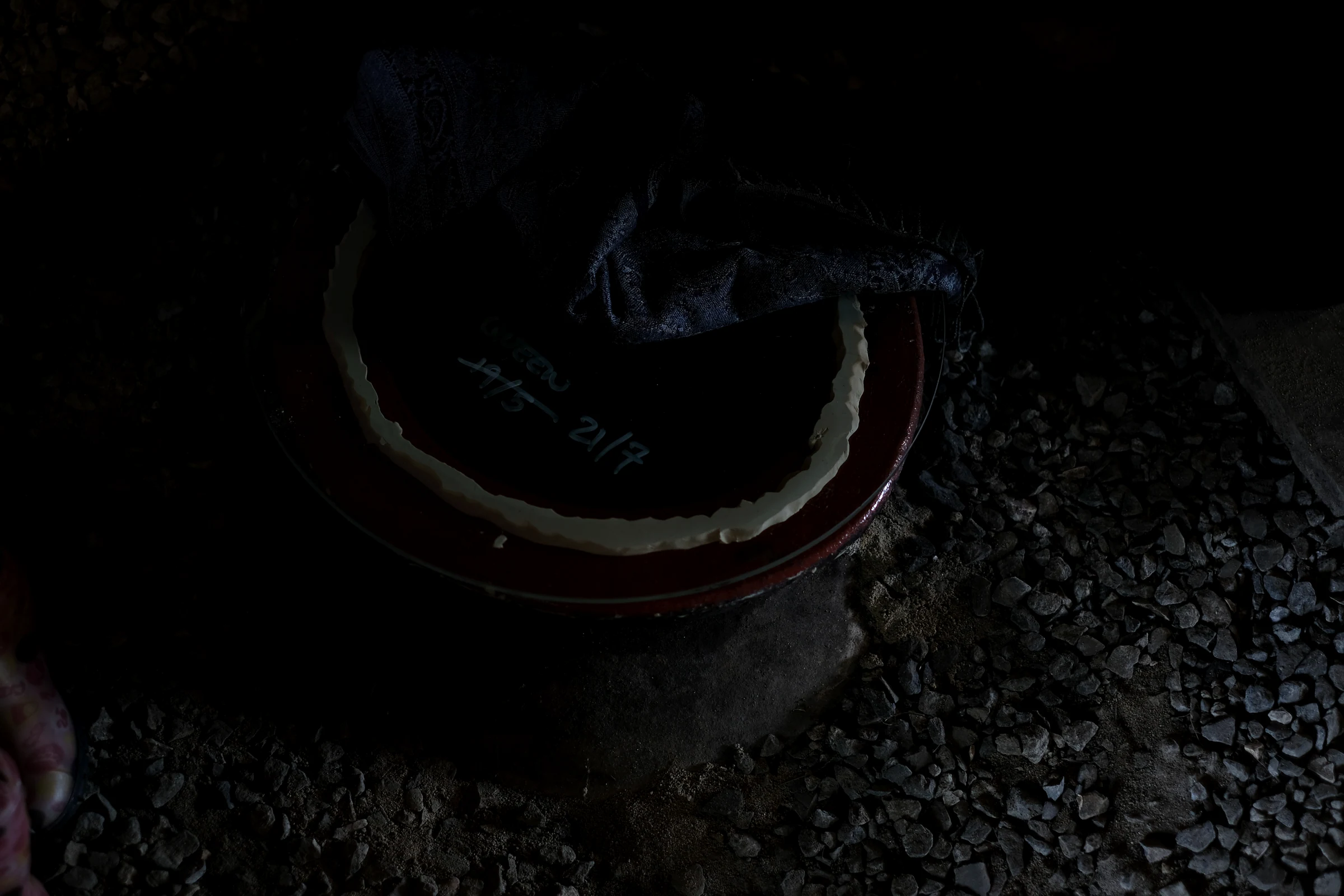
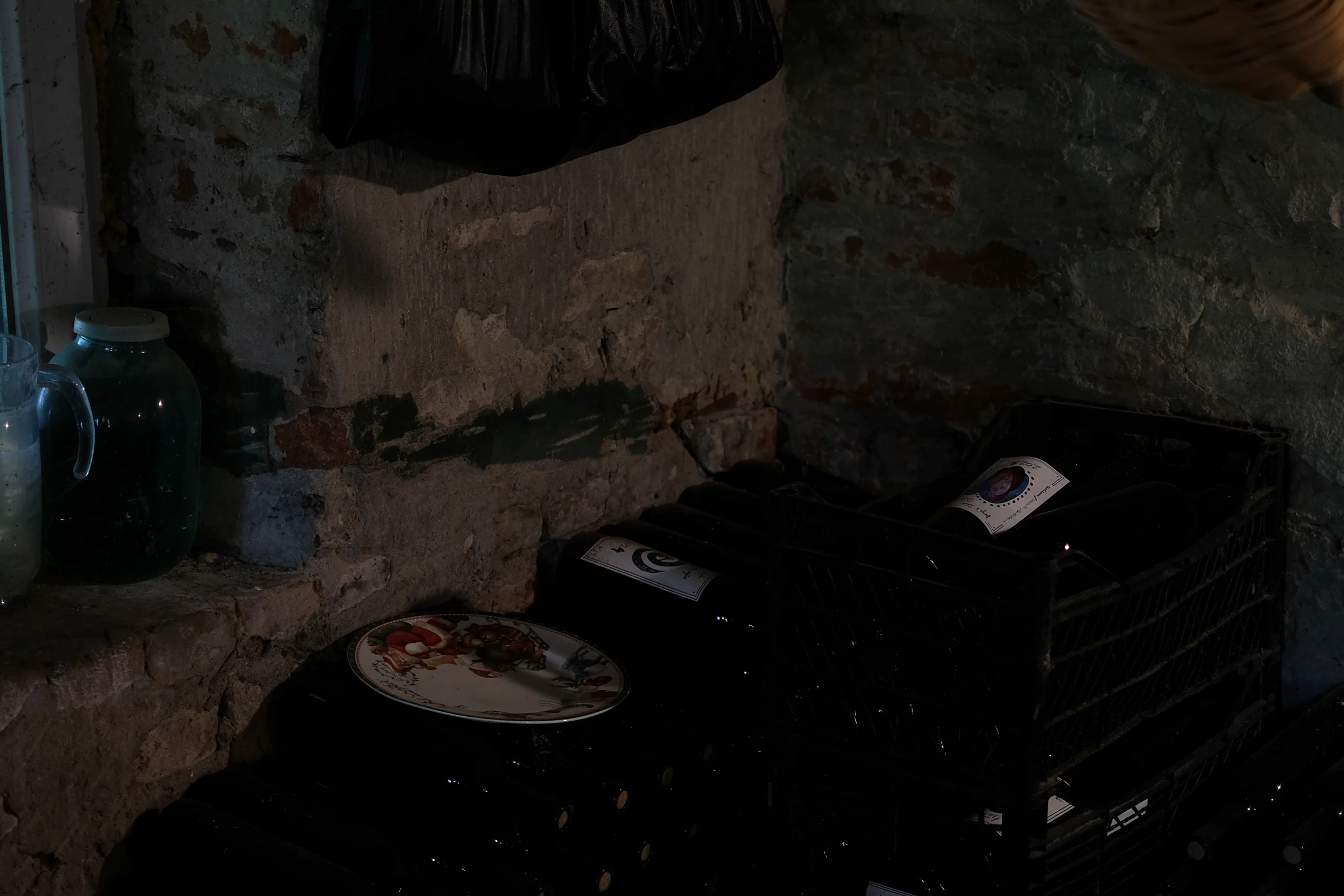
The cellar is small. A few qvevri, glass demijohns, the tools gathered over ten harvests. Two of the qvevri stand above ground. Until about fifty years ago nobody lived in this part of the village, which was thorns and swamp, and the water table is still so high that in winter the saturated clay pushes water into the buried vessels, not through any crack but through the clay itself, which has nowhere else to put it.
Outside, the vines begin a few metres from the door, among pomegranate, hazelnut, fig and pear. Cats crossed the garden. There was a dog. A low band of cloud lay along the mountains, of the kind Tenerife’s winemakers call panza de burro. Esma, Ének’s young daughter, all smiles, stayed close to her mother.
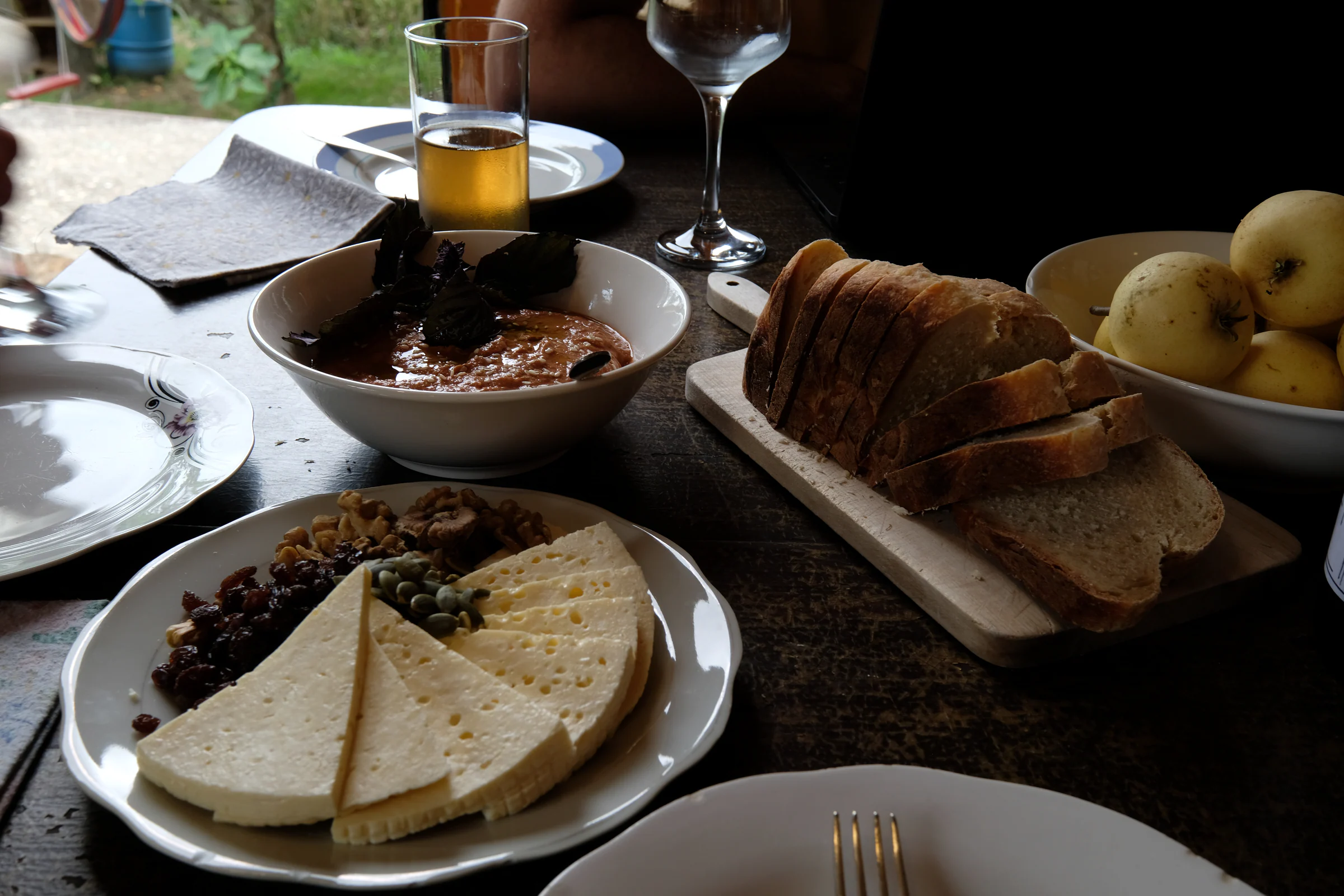
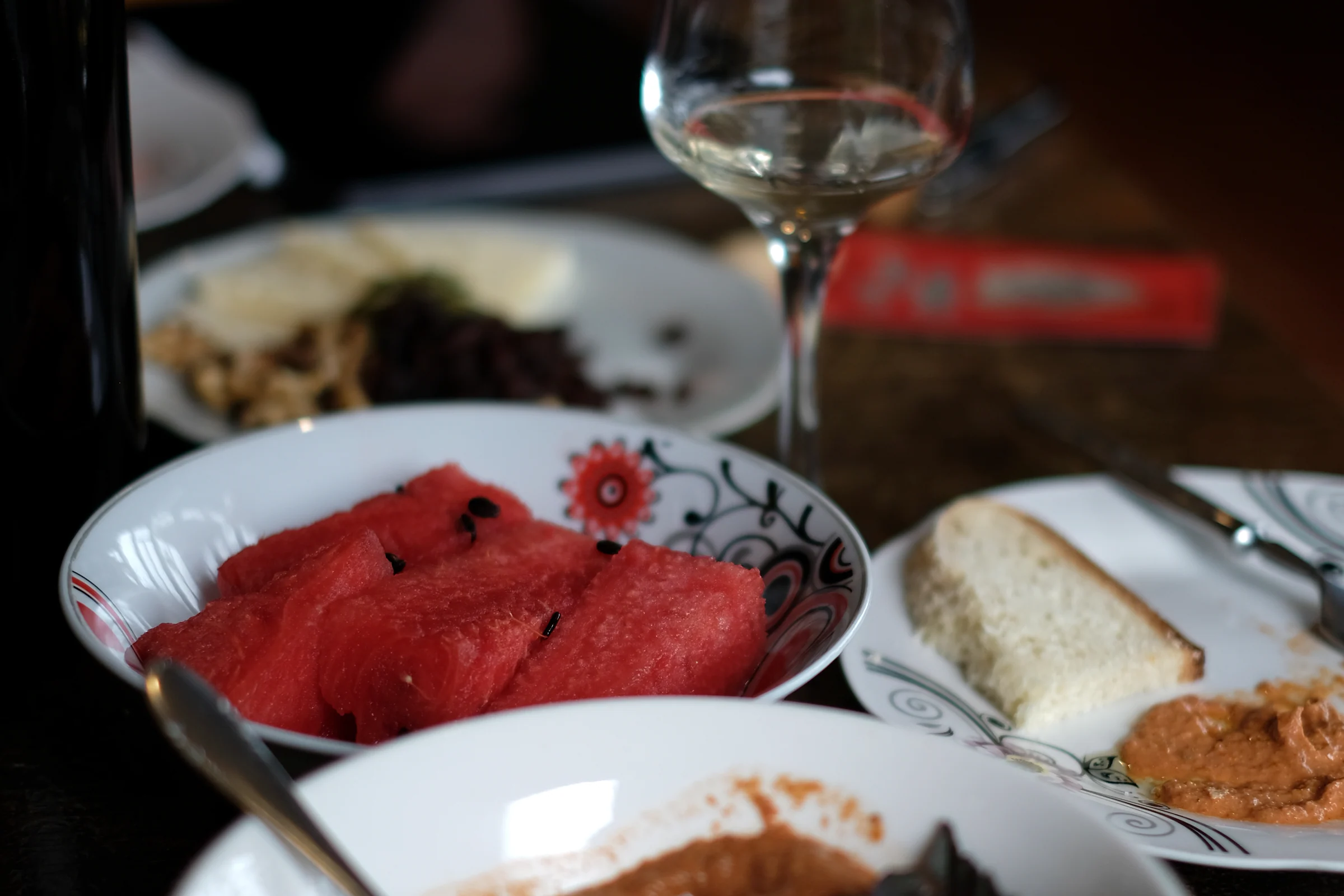
We walked the vines and then went upstairs. The table was set with bread, nuts, a red sauce Ének said was more or less a romesco, and fresh Imeretian cheese made one night and sold the next day. Ének buys it from a woman whose grapes she also buys, and whose cow is kept up beside the house rather than out in the road drinking drainage water. Later she cut a watermelon, dark red and sweet.
The light came down over the garden. The day was warm without being too hot, a cat went in and out of our laps and the glasses kept being filled. We had arrived wanting a bed but by the second wine had forgotten about it.
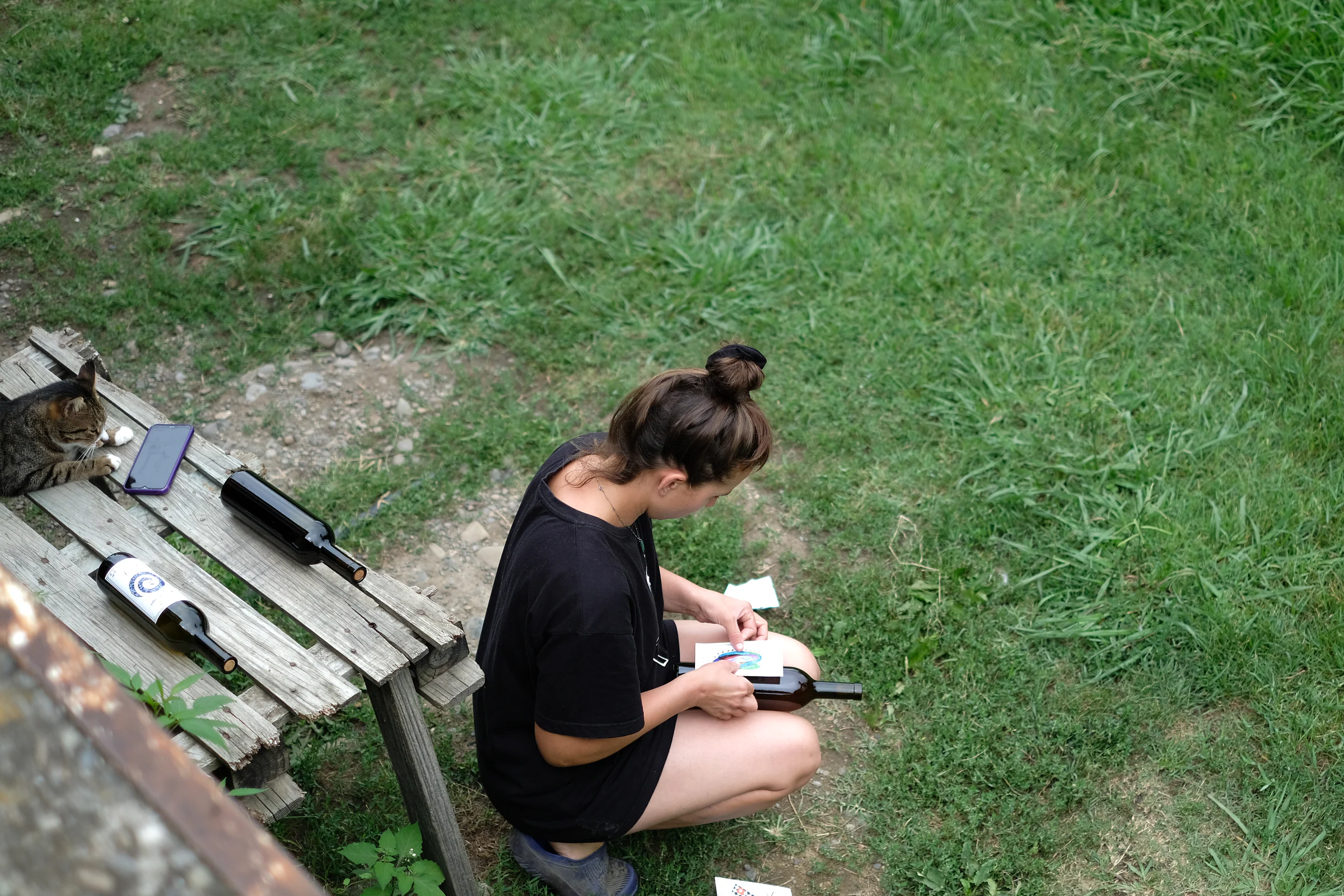
Ének moved between the wines, the food, her daughter and whatever else needed attention, in a cool T-shirt, without any of the choreography that visits to wineries usually involve. Three of the five bottles had been labelled the night before, because she knew she would open them. The last two had not been planned, and partway through the afternoon she went down to glue labels onto them and bring them up. Nothing can be labelled in advance. The cellar is damp enough that the paper moulds.
Esma played beside us, cheerful and entirely unbothered by strangers, and every so often turned to her mother with something urgent in Georgian. We understood none of the words. The sense was not hard to follow: she would have liked her mother to herself.
Ének answered her, came back to the table and opened another bottle. Somewhere in that second bottle we asked how she had ended up in Persati at all.
She had not come to Georgia for wine. She did not much like wine when she arrived. In Boston it had seemed to her a closed culture with its own codes and its own people who knew the correct way to speak about what was in the glass, something that produced distance rather than intimacy. In Georgia she found it in houses, on tables, beside food and work and family, carrying as much history as anyone wanted it to carry and asking for no solemnity in return. That was when it began to interest her.
What had brought her was music. Both her parents are classical musicians. Her father is a cellist and a cello teacher, and she grew up playing the instrument and the Bach suites written for it. Her mother’s family is Hungarian and left for the United States when her mother was sixteen. Ének is a Hungarian word. It means song.
Georgian polyphony reached her through Village Harmony, an organisation based in Vermont that works with folk repertoires from around the world: Georgian, Corsican, Bulgarian, South African, Ukrainian. Many Georgian songs, she explained, cannot be reduced to a melody with harmonies underneath. They need three voices. Take one away and there is no song left to sing.
She came to Georgia to learn that music but eventually stopped singing it. She had heard Georgian women sing the same songs and understood that she would never sing them that way. She loved the music. But she had not grown up inside it.
Bach she kept. Years later she went to Germany with her husband’s band, and one of the concerts was in Leipzig. The next morning she got the whole group out of bed at eight and walked them across the city to the church where he had worked.
“I can’t be in the same city and not go.”
When we said that she was nevertheless making Georgian wine, she corrected us.
“I’m not making Georgian wine. I’m making wine in Georgia. I’m very much influenced and taught by Georgians, but I would never say that.”
She speaks the language, works with the local varieties and the local vessels, and learned the work from her neighbours. The language came first, and most of it came from a bar. Vino Underground in Tbilisi was the first natural wine bar in the city. When she started she could guide a simple tasting in Georgian. Then she was given a month to become capable of talking to any guest who came through the door and to the accountant who paid the producers. Ének would sit down and memorise something like fifty words a day to manage it. Pruning, fermentation, invoices. She acquired the vocabulary of wine in Georgian and in English at roughly the same time. Georgian, she pointed out, is entirely phonetic, which makes it easier than English once the alphabet is memorised. And at twenty you still have the will.
The bar taught her something else, which was how to talk to people in villages about their grapes.
She bought fruit for the first time in 2019. By 2022 she needed more, and with Esma still small enough for a pushchair she walked the roads above the house asking who owned which vineyard and how it was worked, and found two or three growers with roughly the quantities she was looking for. One of those walks produced the Tsolikouri she now buys for Queen of the Night, from a thirty-year-old vineyard, fifty to a hundred metres higher than her house, on a slope facing east and south, worked by an electrician who has no time to do anything extra to it.
Mimoza came through a friend whose mother had grown too old to keep making her own wine. The vineyard is fifteen minutes away by car, in the next village, and then you park, because the car cannot go further, and walk down one hill and up another until you find it in the middle of the woods. The vines are sixty or seventy years old, planted by the family of Mimoza’s late husband, and trained low, which is unusual there. Almost everything around it is on pergola, the western Georgian answer to humidity, much as it is in the north of Portugal. In the cellar they referred to the wine by the name of the woman who had grown the fruit. Mimoza. There was eventually no reason to call it anything else.
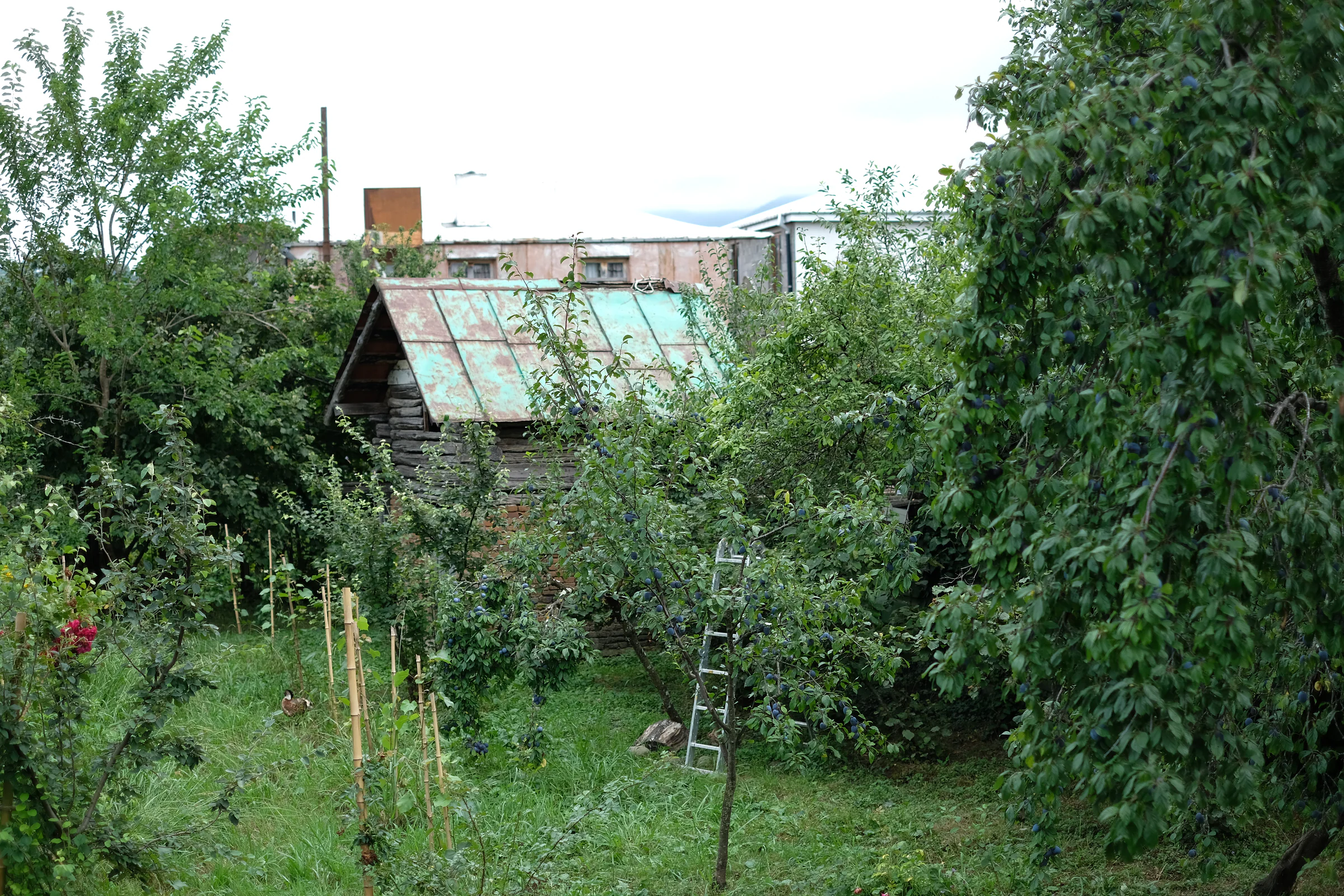
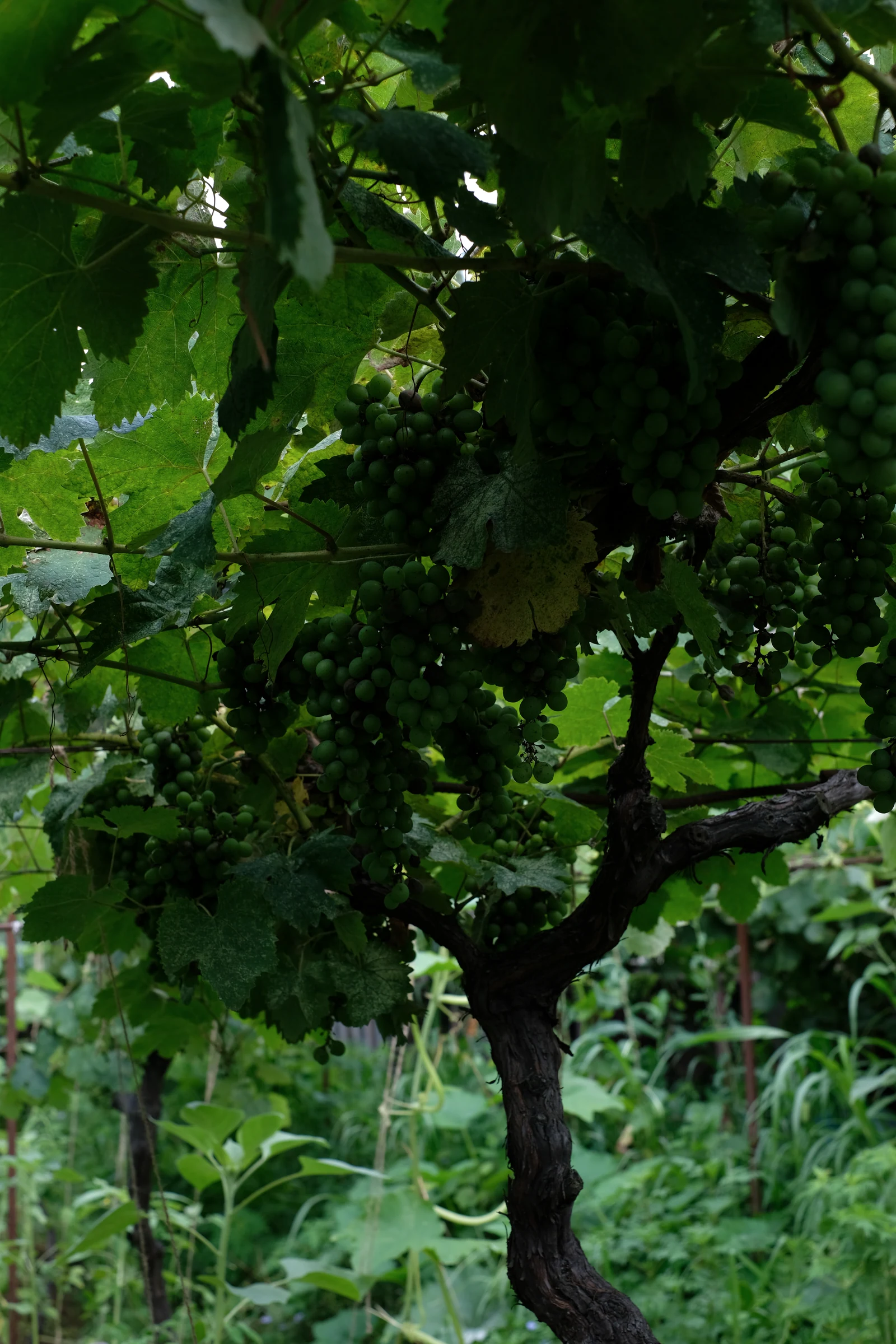
Whichever vineyard the fruit comes from, it is crushed by foot and goes in whole. The first time she tried to destem by hand she was sitting alone in front of five hundred kilos of fruit. After two hours she stopped and put everything in together. Other winemakers had warned her against the stems of western Georgia. She used them because she had no destemmer, then paid attention to what happened.
“Everyone said for many years you cannot use the stems. I think it’s the stems that also help these ones.”
The seven-month maceration arrived by a similar route. She had gone from four months to five to six, disliked the wine at six and decided to go back to five. Then, at the end of February, after a very warm winter, a metre of snow fell in three days, higher than the porch, so that they stopped using the steps. The electricity went, and with the electricity the water. Moving wine in snow is survivable. Moving wine with nothing running is not. She waited another month. That was the 2023, and she loved it. Seven months with all the skins is now what Oh, the Wind and the Rain gets every year.
“Everyone likes to speak about terroir,” she said, “but I think you also need to speak about the winemaker’s impact in the cellar too.”
That impact includes the shape of a life. Esma’s father is a musician who plays punk, and during harvest he arrives with three whole bands to help, which she called ridiculous and clearly enjoys. The rest of the year Ének works mostly alone, and pressing, racking and bottling have to fit around a child’s schedule. Bottling sometimes begins at ten at night and continues until it is finished.
She follows the moon calendar as closely as she can. During harvest and bottling, she pays as much attention to it as circumstances allow. She bottles around the full moon because she believes the wines are fuller of life then, and that is what she wants to preserve in the bottle. When pruning, she tries to stay away from the waning crescent as much as possible. Sometimes it works out. Sometimes it does not.
We asked about biodynamic preparations. She had tried them for a year and stopped, for lack of time. She thinks they would help. The soil under the vines is poor, dusty in places and taken over by one very invasive grass, and where the garden has already reached the vineyard it is visibly better. Every year she moves the garden forward by one row. Asked what she would change, she said that being able to walk in the vineyard is the bare minimum, and then talked about leaves and air circulation, and about pruning. She has been pruning her pergola the way she has seen it done in Italy rather than the way it is usually done here, tying the new growth down in the right direction as it grows, which makes the following year easier. In the cellar she would like more storage. She does not want air conditioning.
Her Aladasturi is foot-crushed with its stems, then ferments for three weeks in a plastic vessel with all its skins and stems, and in 2024 went straight from plastic into glass. It is a grape most people gave up on: thick bunches of thin-skinned berries that look perfect from outside and rot from the middle, and a strong preference, once in the cellar, for turning into vinegar.
“I love this grape so much. I’m obsessed with it.”
It was the first Aladasturi we had tried, and it sent us looking for the grape for the rest of the trip. Crunchy red fruit with the acid still in it, a spiced edge, elegant, entirely without weight.
Esmeralda is made from the vines outside the house (Tsolikouri, Krakhuna and Aladasturi), and follows an old local sequence rather than a blend. The whites go in with their skins and stems for twenty-four hours. The red is picked around three weeks later and goes straight into the same vessel, whole, where it starts a second alcoholic fermentation and stays three weeks before moving to glass. It comes out closer to a rosé than to anything else, light, herbal, with a live and springy structure underneath.
Queen of the Night 2024 had been the first wine of the afternoon. Tsolikouri, crushed by foot, twenty hours in the press, into qvevri with no time on the skins. After twenty-four hours she racks it off the first deposit, all the debris that falls out of the fruit in the first day, and it stays in clay for close to a year, moved from one qvevri to another three or four times and never into glass. Lime and apple, herbs underneath, a hint of smoke that she says she cannot account for, and a beautiful acidity. Of everything on that table it was the thing that woke us, and the one that kept complicating itself the longer we sat with it.
Mimoza 2024 spent ten days on all its skins and stems. Yellow fruit and a great deal of herb, in a shape we recognised from skin-contact Alvarinho, and a firmer tannic frame than the colour suggests.
Oh, The Wind and the Rain 2024, the seven months, pushes further into herb and dried stem.
Five wines across different varieties, vineyards, vessels and lengths of maceration, with the same hand in all of them. Pure fruit, herbs, acidity, no weight anywhere. The labels declare between 10.7 and 12.6 per cent. None of them is trying to be large. There is also a semi-sweet wine, possible only in some years, which depends on racking often enough during fermentation to arrest it, and which she could not catch in 2024 because the fermentation went too fast.
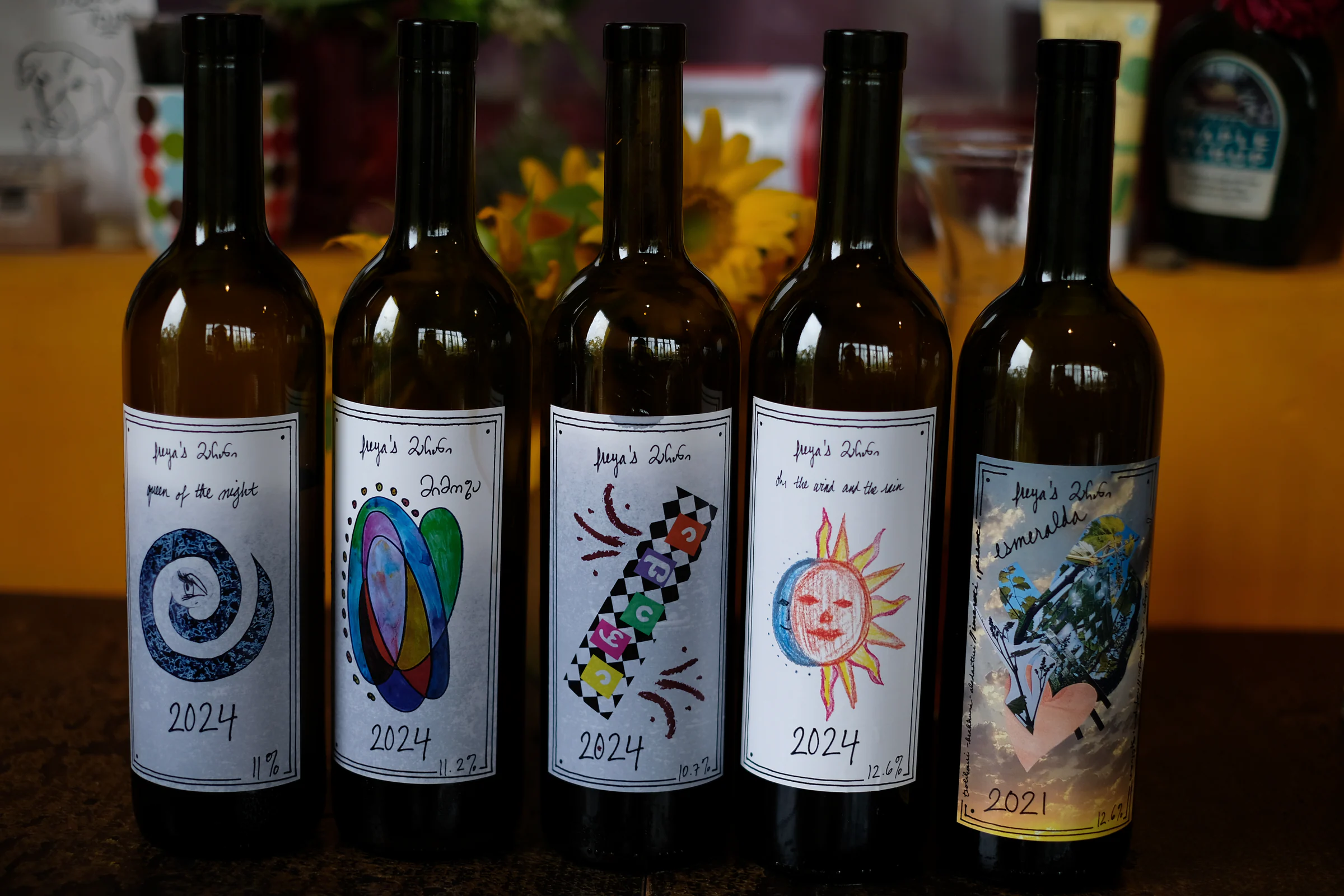
We had told her the labels were beautiful, and they are: collage, ink and crayon, made by Ének or by someone in her family, none of them looking like the output of a studio. The one she is often asked about is a spiral with an eye at its centre, which people read as a biodynamic reference; she made it at fifteen. Her husband did another. One of them is a drawing her sister made at ten years old, on a birthday card. The same sister came to stay a few weeks ago, sat down in the vineyard and drew for the first time in a decade, and Ének wants more of that on the bottles: hand drawn, simple.
Esma’s drawings are not on them. Children’s drawings have become a trend among Georgian producers, and she does not want to send her daughter’s work around the world without asking her first.
The bottles themselves leave for a shorter list of countries than they used to. The wine goes to the United Kingdom, the Netherlands and Japan, on and off to Denmark, and used to go to Australia. This year very little is moving anywhere. Ének blamed the country she was born in, which, as she put it, had nothing better to do than destroy the world shipping situation, and noted that wine is never the priority cargo when everything is stuck.
We asked whether she had managed to see much of the country. “I was able to explore Georgia most when I did not know that I was staying,” she said. In the first year or so she went around the country visiting winemakers. Now there is the house, the cellar and the child, and what travel she does happens through her husband’s family: villages she would never have reached otherwise, and one summer a crossing of the mountains behind the house with her sister-in-law, hitchhiking, and the following summer by car. You drive up through moss hanging off the trees in the humidity, then past the pines, then above the treeline where there is nothing but grass, rock, cows and cowbells, and come down the other side into a different climate, that close to home.
Late in the afternoon the conversation came back to Bach. Pedro Eiras, who supervised the doctorate of one of us, has listened to him every day since something clicked, and has written a novel called Bach. Ének wanted to read it, and wanted it for her father, the cellist. We searched at the table and found nothing. Eiras told us afterwards that the novel exists in Italian but that there are no plans for an English edition.
We stayed at the table for approximately three hours. The cats came and went. Queen of the Night was still changing in the glass.
We told her that the wines felt alive, and that instead of flattening us they had done the opposite: we had arrived barely able to formulate a complete sentence and were somehow more awake than when we got out of the car. Perhaps it was the energy in the wine.
“Probably,” she said.
On the way out she said that her own life sometimes puzzles her. She cannot leave the house for long. There is Esma, there are the cats, there is a cellar that somebody has to move, and none of it is easy.
We forgot to ask where the name of the winery comes from and asked afterwards, by message. Marani is the Georgian word for cellar. Freya is the Norse goddess: “female power etc etc,” she wrote. A minute later a second message arrived. “I was under the unfortunate impression at the beginning that one person could make wine, realized quickly that that is neither true nor fun.”
It is a hard life. From a chair overlooking that garden on the last day of July it also looked like a beautiful one, and saying so is not the same as making it picturesque: the difficulty is the other half of the same thing, and she is the last person who would separate them.
There are wines we cannot fully account for. Hers are five of them. What they have in common is not a technique, since almost nothing in the cellar is done the same way twice, but this: they carry the life they came out of, without arranging it. We carried three of them back to the car. We will remember this when we drink them.