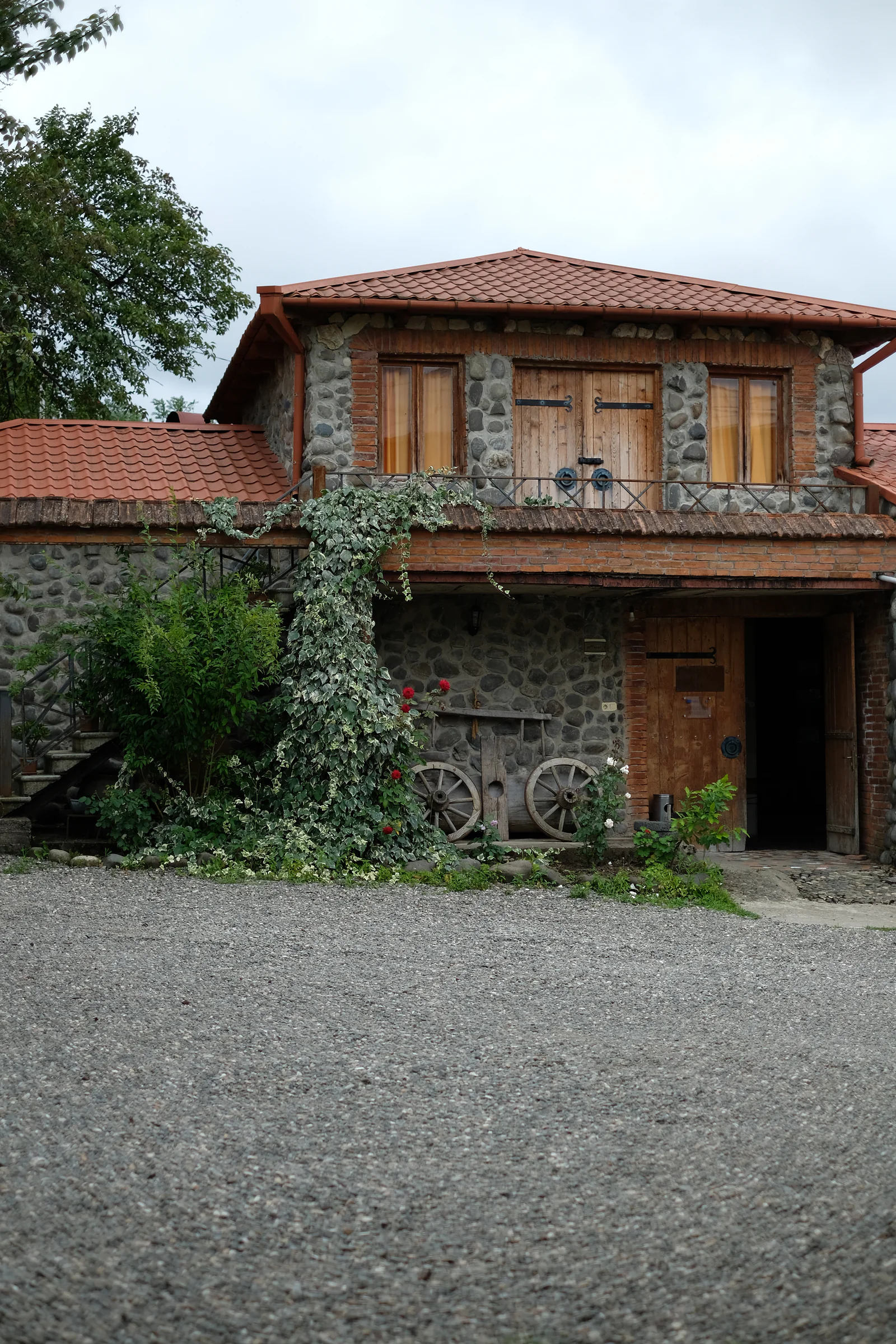
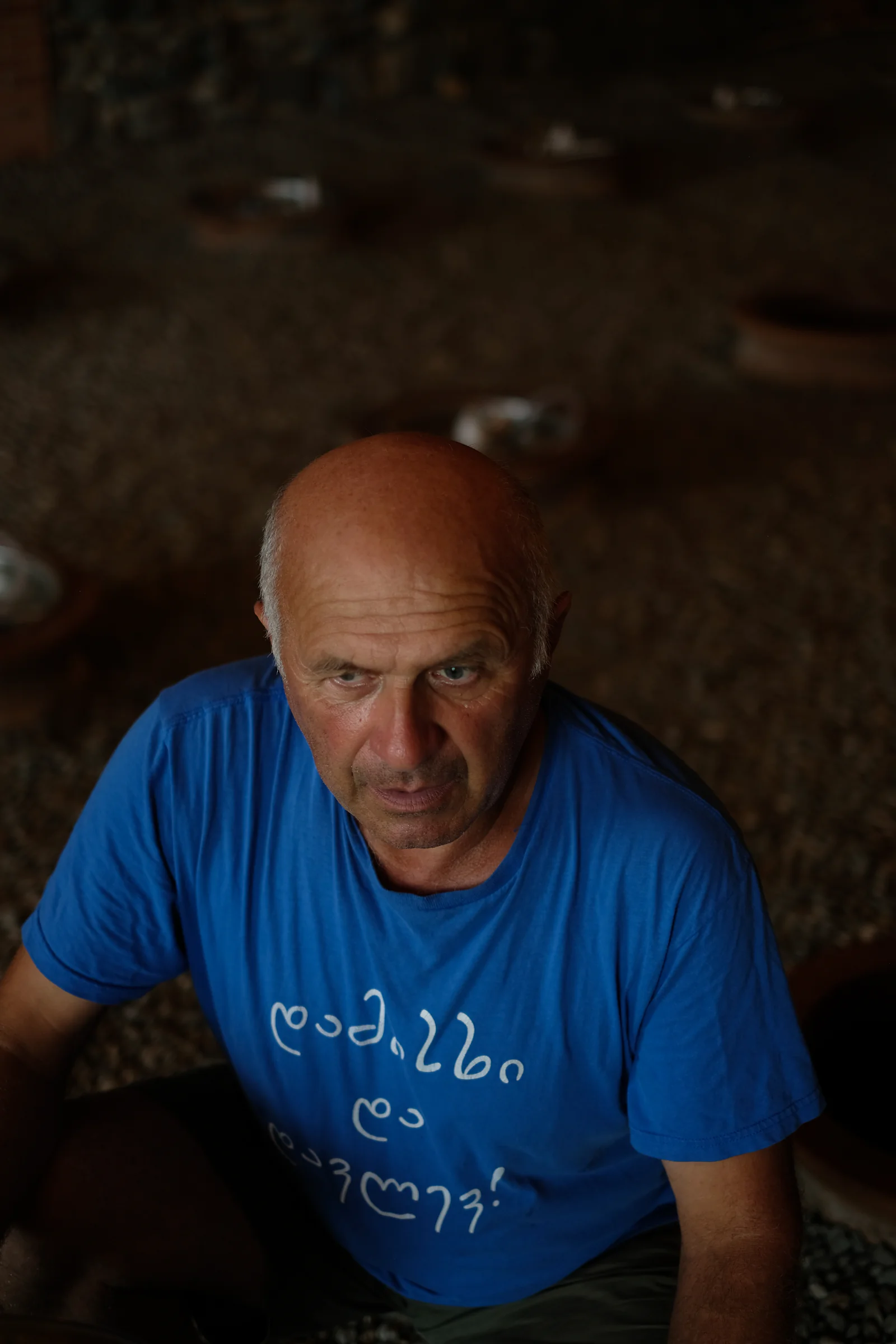
The visit was arranged with Baia by email. We knew from the start that she could not be there. She organised the afternoon anyway. And in detail. Her father received us on Saturday morning, the first of August, together with Bingo, the family’s large but cute dog. Temo, our Georgian driver around Kutaisi, spoke English and came along with us, so at times the visit moved between two languages through him.
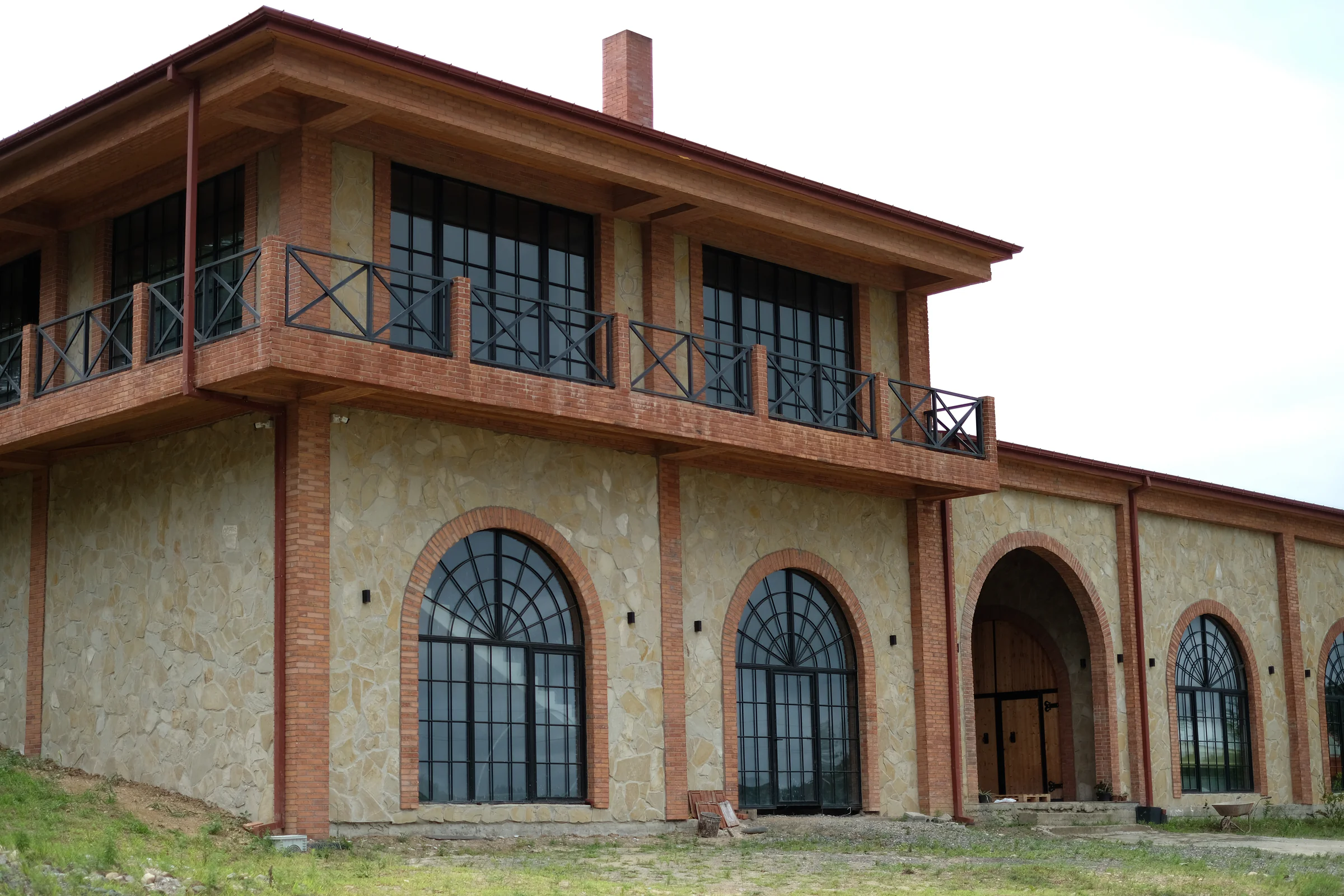
Before seeing Baia’s Wine main location, we got back into the car. The family is building another space nearby, a large new structure intended both for making wine and for receiving people. There will be rooms for guests, meals, and a broad terrace with an incredible view. Although the building was unfinished, the qvevri were already in the ground.
Baia’s father uncovered one of them. Temo translated his instructions for opening a qvevri: sit down, be in a good mood. The wine likes singing. He made the sign of the Trinity over the opening and drew out a Tsolikouri for us to taste there. It was fresh and vibrant, and it came without a bottle, a label or a tasting room around it. Directly from the clay, it tasted alive.
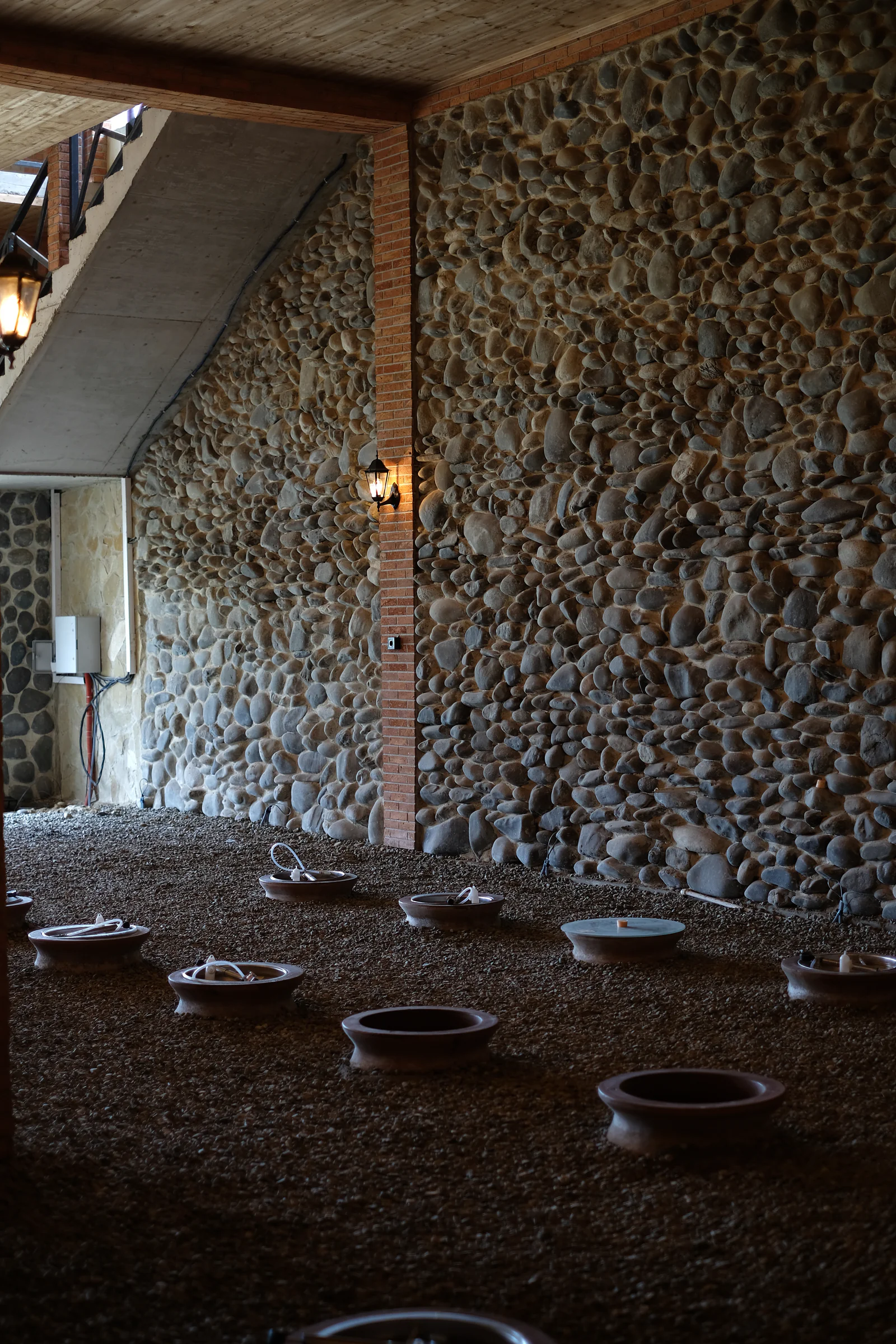
He spoke about qvevri of different sizes, some holding a thousand litres and others five thousand, and about the yearly work of emptying and cleaning them. The vessels had come from a place he associated with terracotta and with the people who still know how to make it. For him, their presence in a new building did not represent a reconstruction of the past. This was simply the same way the family had always made wine, now continuing in a place designed for the next part of its life.
The new site looked out across a wide landscape. The vineyards sit at around 300 metres, on alluvial soil with clay, gravel and limestone. At night, cold air drains off the surrounding hills into the valley and sharpens the drop in temperature. That is the standard technical account of why wines from this village hold their acidity, and the Tsolikouri from the qvevri had made the argument before we read it anywhere. The terrace was planned for crushing grapes before the juice went down into the qvevri, but also for food, music and visitors. Production and hospitality were not being planned as two separate things. Even unfinished, the building was already being described through the people who would gather there.
We drove back to the family winery. In a small room, newspaper clippings and photographs traced the attention the project had received beyond Meore Obcha: the Forbes 30 Under 30 Europe listing in 2019, when Baia was twenty-six, and later a German documentary made for ARTE. Old labels and bottles sat beside objects from the family’s winemaking: wooden implements, a hollowed gourd used for pouring, the equipment with which they began bottling, and the tools used to clean the qvevri. It was part archive, part working memory.
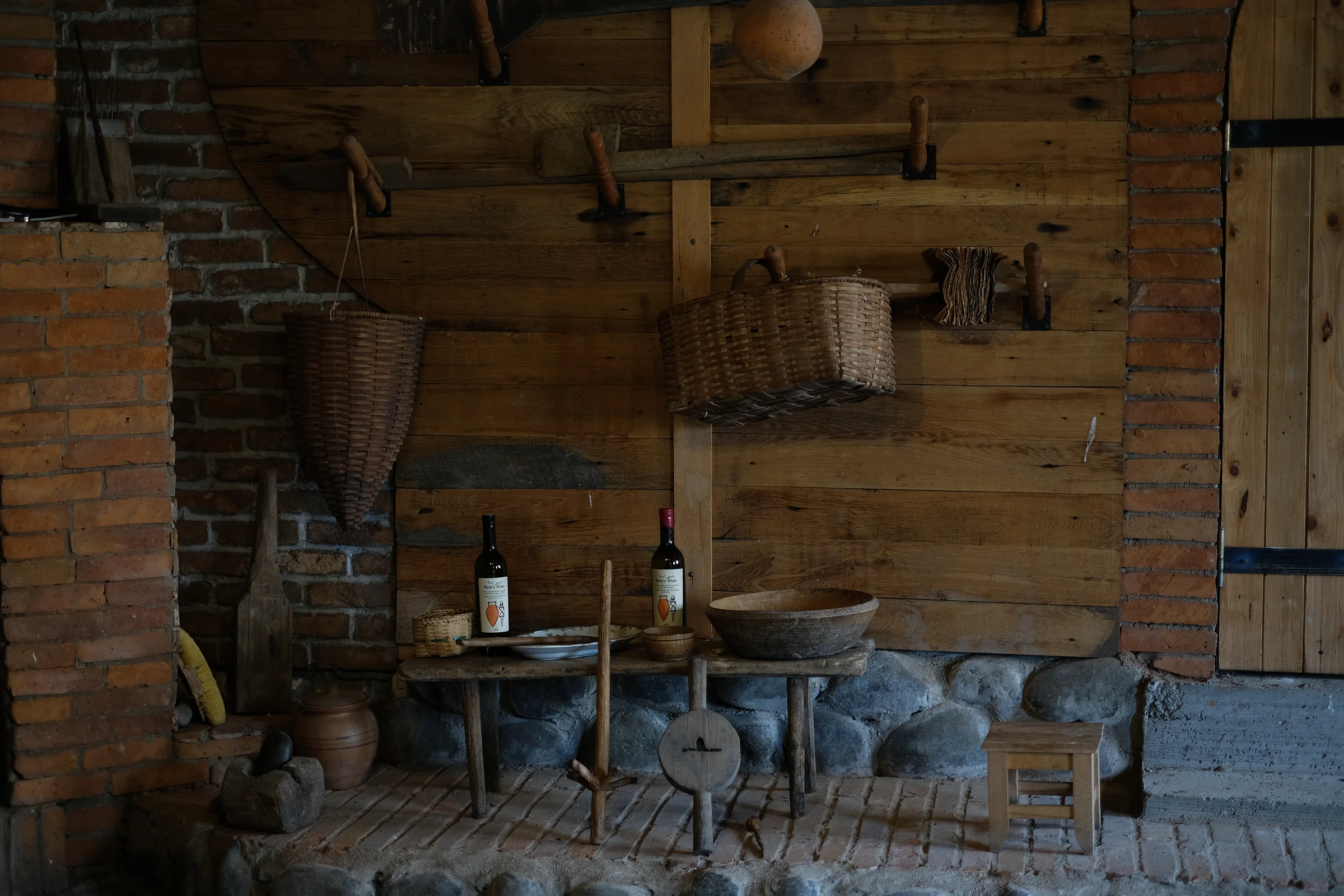
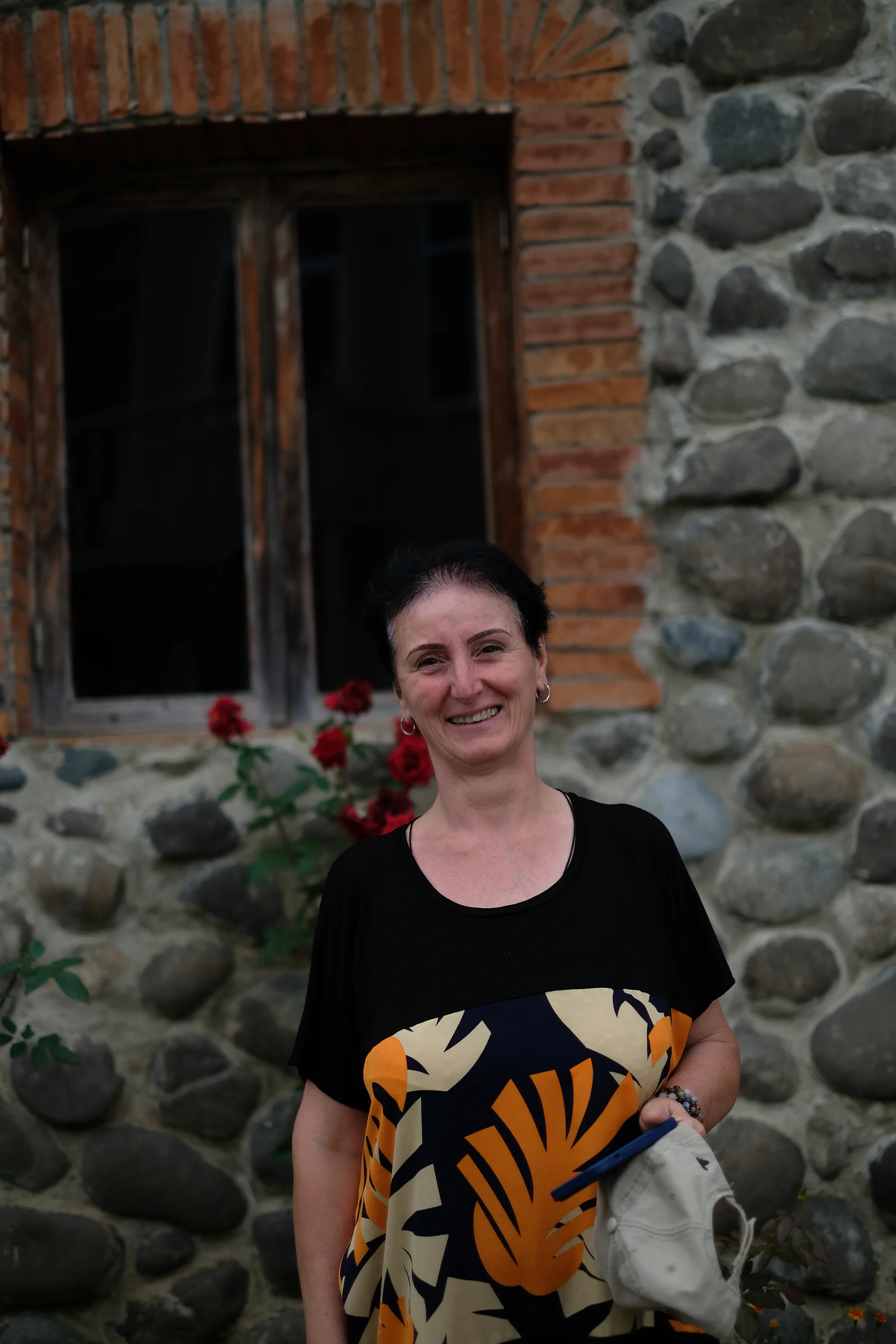
Baia’s mother joined us there and told the story again from inside the family. Five generations have lived on this land, she said, and wine was part of the household long before there was a company. It was made in qvevri and circulated close to home, served to family and neighbours and sold around Imereti, including to restaurants, without the bottle becoming the centre of the exchange.
That changed in 2015. Baia was twenty-two and studying in Tbilisi. She kept seeing wine offered in bottles and came home with a simple proposal: they should put the family wine into bottles too. A grant of 5,000 lari paid for the beginnings of a small system: a corking machine, a pneumatic filler, bottles, and whatever else was needed to move from local, unbottled wine to a labelled product.
The grant financed packaging, but the change did not stop there. The Imeretian method the family had always used is a short maceration with a small fraction of skins, commonly five to ten per cent, which is what separates the wines of this region from the long amber macerations of Kakheti. In the years after 2015 they extended that contact considerably, in some cases to a matter of months, and began treating each qvevri as its own decision rather than as one operation repeated.
Her mother also showed us one of the first bottles they kept. She no longer knew what was inside it, wine or vinegar or something else, but that was no longer the point. The bottle had become a record of the moment when a family practice changed scale and direction. The winery carries Baia’s name because the idea to make that change was hers.
The family history did not become a story of one person leaving the village and returning as its rescuer. The three children studied away from home and brought different kinds of knowledge back with them. Together they expanded the work into white, red and sparkling wines, as well as chacha. The first bottling was five thousand bottles from two varieties. Now, the family produces around 60,000 bottles of wine from 10 hectares of vineyards, with another 8 hectares planned for planting. Their mother spoke less about the international destinations listed in the room than about the fact that her children had chosen to come back, and that the project now also creates work for other people in the village during the harvest season.
Then the visit moved to the table.
Lunch was exceptional, in quantity and in care. There was homemade bread and khachapuri, free-range chicken, a fragrant green bean lobio, and plate after plate of vegetables: aubergine, cabbage, beetroot, carrots, green and red peppers. Several came as pkhali, bound with walnuts, garlic, coriander and spices. Other salads were dense with fresh herbs. Walnuts, vegetables and herbs kept changing the weight and texture of the meal, making a large table feel varied rather than excessive. The fruit that followed was as good as everything before it.
We tasted Tsitska and Krakhuna, both 2023, and then an Otskhanuri Sapere. The Imeretian whites are made under Baia’s name, while the reds and the sparkling wines carry Gvantsa’s. The Tsitska showed some green apple and citrus, and underneath them something herbal, maybe fennel, or a herb with some sweetness in it. The acidity was moderate rather than cutting. The Krakhuna went the other way: yellow fruit, a little stone fruit, rounder and with more weight in the mouth.
The Sapere was 2024. Deep purple, black fruit, violets, and a texture at once intense and surprisingly silky at twelve degrees. What came after the fruit sent us home: bergamot, and esteva, the rockrose that grows over the schist of the Douro. The violets had already reminded us of Touriga Nacional. The association came from Portugal, but it gave us a first impression of a variety we were only beginning to know. We met Gvantsa that day as well.
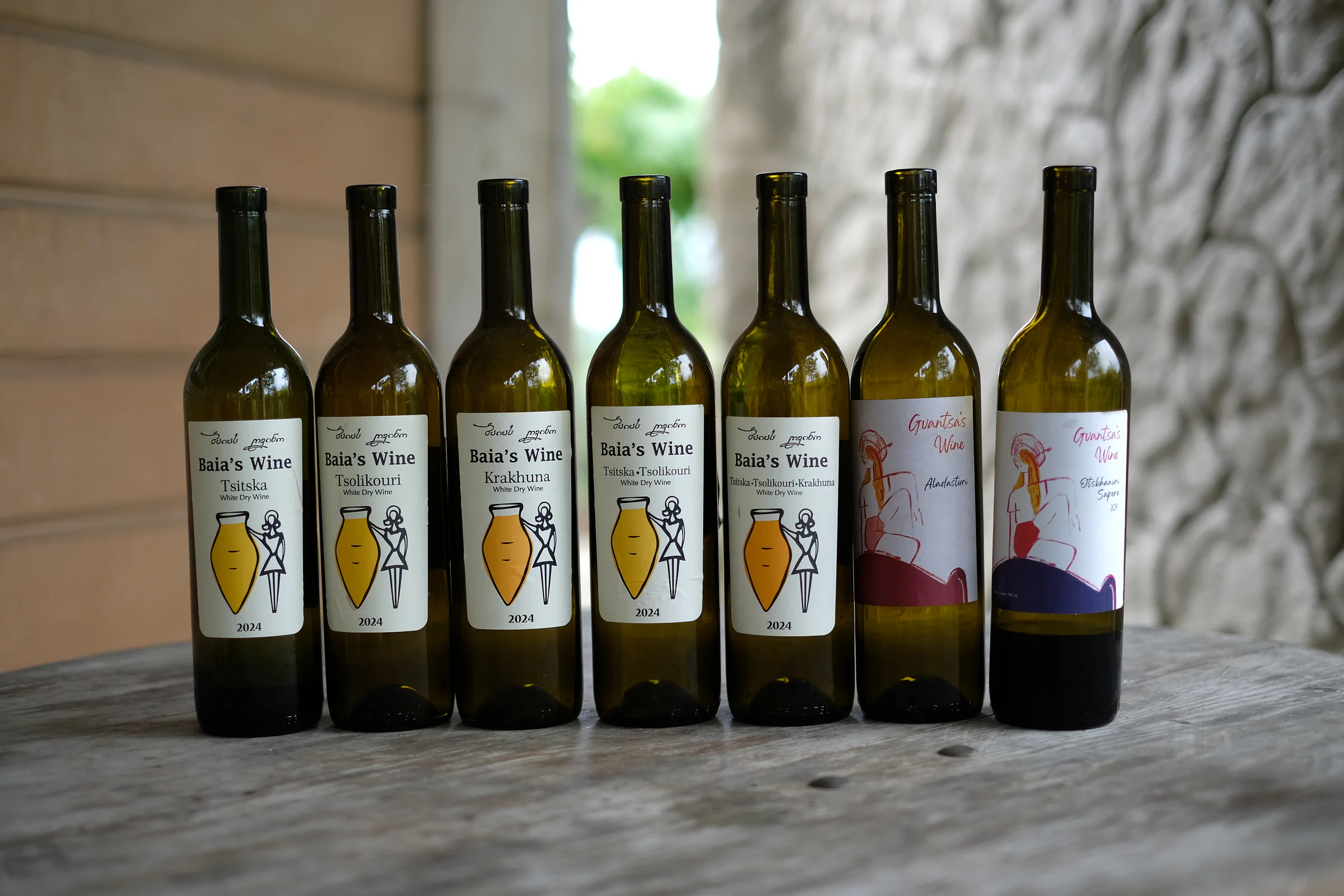
We left with two bottles that we would drink a few days later. A red Aladasturi, fresher and lighter than the Sapere, and a Tsitska pét-nat that sent us back to Portugal a second time, as it reminded us of the sparkling wines of Bairrada.
The project bears the name of the daughter who first insisted that the family wine should leave Meore Obcha in a bottle. On the day Baia could not be there, what we saw most clearly was everything around that name: the family, the qvevri, the objects kept in the small room, and a table large enough to make visitors part of the afternoon.
Driver in Imereti
Temo accompanied us as our driver throughout our visits in Imereti. Anyone looking for a driver around Kutaisi can contact him on WhatsApp at +995 591 08 70 81.