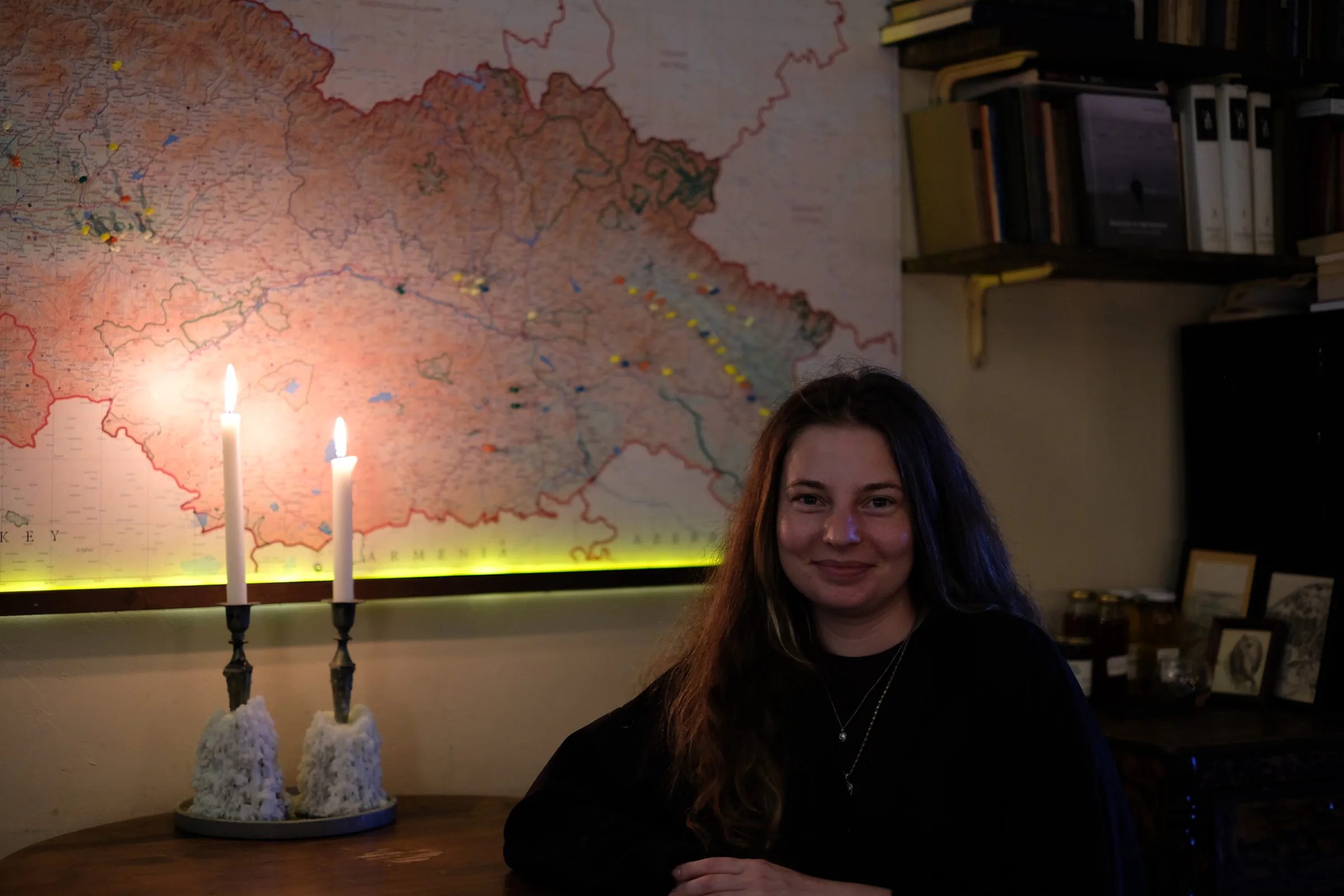
It had rained during the afternoon in Batumi. By nine the rain had stopped, but the air had kept the water: warm and humid, though not excessively so. We sat outside at MIDI Wine Bar & Shop, at a table on the sidewalk, and finally met Aleksandra Novikova.
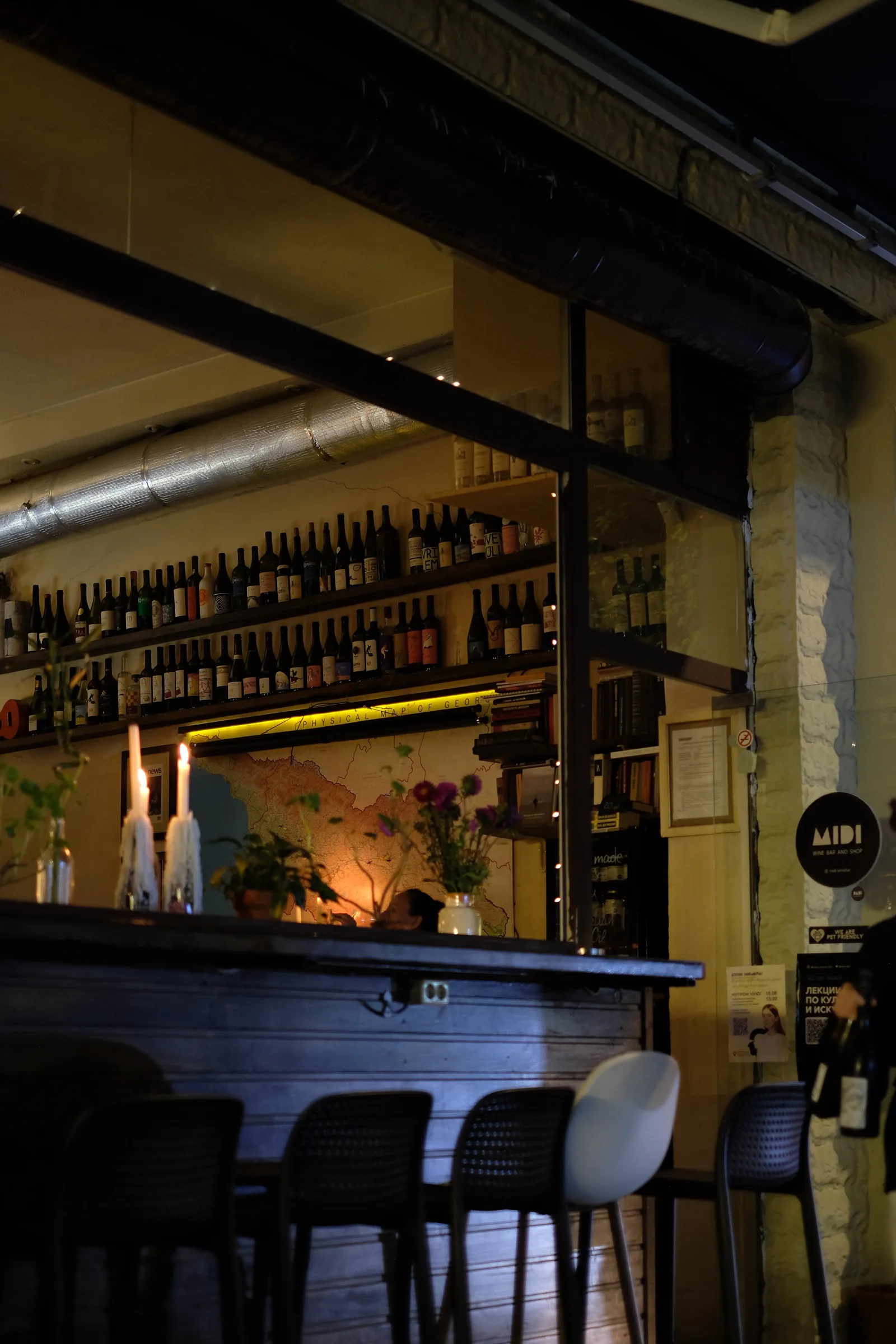
We already knew her as Sasha. In fact, before we had met her, we had reasons to be grateful to her. We had written to MIDI on Instagram while planning the trip, hoping to arrange a conversation with her for Enoversa. We had not asked for recommendations. Sasha began offering them anyway, sending names, telephone numbers and introductions. She put us in touch with several producers in Imereti and continued trying when plans changed or somebody could no longer receive us. By the time we arrived in Batumi, two encounters of the trip, with Ének Peterson and Ramaz Nikoladze, had happened because of her. There had been no advantage in this for her. We were strangers on the other side of a message. Yet she simply tried to help.
Sasha was born and grew up in Russia. She went to a school that taught English and Spanish intensively, then to university to train as an interpreter. She was living in Moscow, and content there, when her father called in 2017.
He had travelled widely and worked in hospitality, in Egypt, Indonesia and Switzerland among other places. A friend who had decided to raise his child in Georgia made him curious about the country. He came, tasted the wines, and decided to open a wine bar in Tbilisi. Then he asked his daughter to help him for one summer.
She did not want to go. Still, she went, and fell for the country, the food, the hospitality, the sun. At her father’s bar she was offered a choice between working with wines she had never tasted, which she did not yet know how to discuss in English, and working in the kitchen. She chose the kitchen, although she did not know how to cook either.
Wine entered after service. Her father did not want open bottles left overnight, even after the air had been taken out, so he told her to drink what remained. Sasha tasted while washing down the kitchen at the end of the day. Winemakers began coming to the bar because he paid them immediately, supported their work and had built a reputation they trusted. When a table filled with food and bottles, he called into the kitchen: daughter, come. She met the producers there. On her days off she followed her father to their villages, asked questions, ate grapes, and watched what happened in the cellar. There was no course. There was work, and there were tables.
Later he proposed a second bar in another large city and told her to go to Batumi. Sasha found the place and renovated the interior herself. That was five years ago. She turns thirty-four in November.
The distinction between the two generations matters to her, and it is complicated by a coincidence: father and daughter share the same name. At the beginning, producers at wine fairs greeted her as Sasha’s daughter. They no longer do. She has her own business, pays for wine in advance, and has formed her own relationships with the people who make it.
That night, bottles began to gather on the table. Sasha promised to show us different styles and turned the tasting into a route across the country. The sequence was generous. A producer led to a village, the village to another bottle, the bottle to somebody she thought we should meet. Several times she stopped to find a number on her phone or offered to make an introduction immediately. We had come to taste with her. She was still offering to plan the rest of our trip.
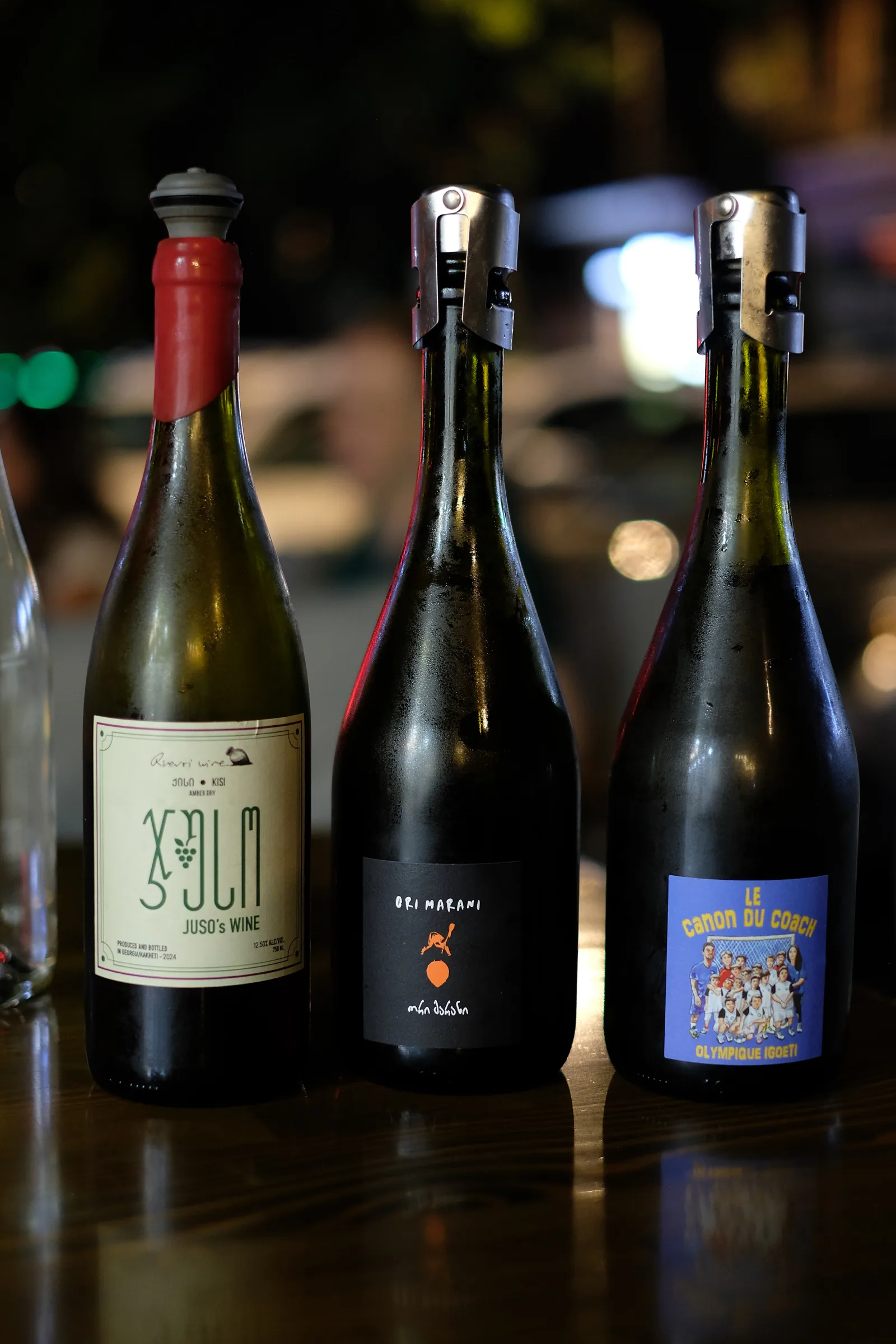
We began with Ori Marani, in Igoeti, Shida Kartli, where Bastien Warskotte, who grew up in Champagne, makes traditional method sparkling wine with his Georgian wife, Nino Gvantseladze. Sasha explained the choice of grapes through the Soviet sparkling factory that once worked in Kartli with Chinuri and Goruli Mtsvane.
Then west. A Tsitska from Bediani, made by one of Ramaz Nikoladze’s students in Terjola. Ramaz has no children and treats the young winemakers of his village as something between apprentices and heirs, teaching them, supporting them, taking them to fairs.
Two wines by Archil Guniava followed. The first brought Krakhuna together with Dondghlabi, one of two nearly lost varieties Archil has spent years bringing back. The second was Dzelshavi. Both were among our favourites of the night. Sasha spoke about him with particular affection. His wines have been poured by the glass at MIDI throughout its five years, and she values the fact that he never seems satisfied to repeat what everyone else is doing. When one producer put Otskhanuri Sapere in oak, she said, everyone put Otskhanuri Sapere in oak. Archil changes the blend because the harvest changes.
Food arrived without being ordered. A board of delicious cheese, with types almost impossible to find in Batumi, and delicate honey from Guria. We had been mildly disappointed by cheese in Georgia until then, having met little beyond sulguni and imeruli in the places we had eaten. These were not those.
A Krakhuna from Mirianis Marani took us back to Persati, Ének’s village, made by her neighbour. Then an Aladasturi from Makaridze, carbonic maceration, light and cold. Sasha told us the story on the label. The vineyard caught the blackbird eating its grapes. The bird asked to be let go, and promised that in return she would sing to the grapes so they would grow in harmony. The vineyard agreed. She still eats them and she still sings, and the balance holds.
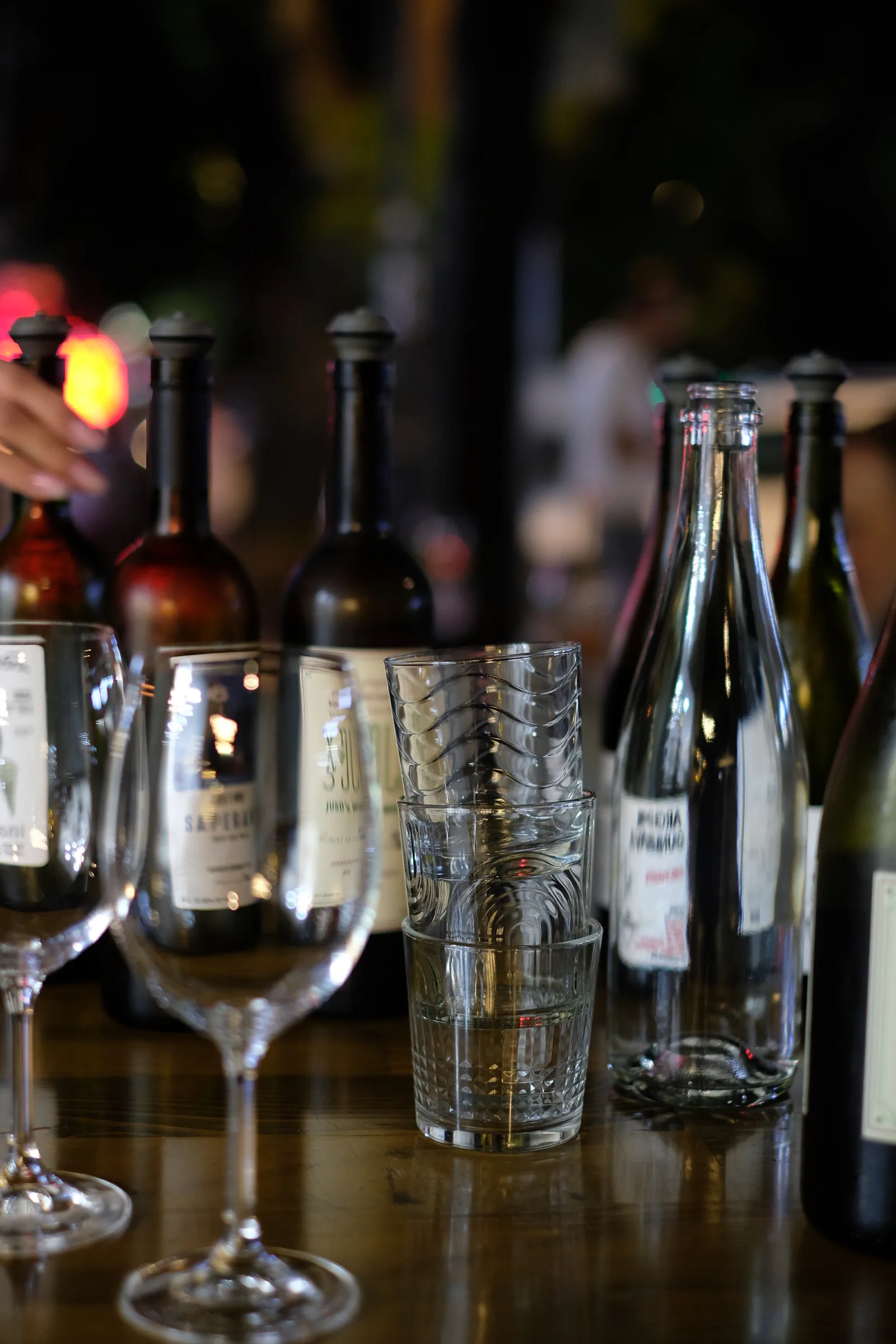
Somewhere between the whites and the reds Sasha gave us the lesson we have quoted most often since. Every Georgian grape is white inside except Saperavi. Peri is colour; sa-peravi is the thing that gives it. So the reds can be ordered by how much pigment the skins are willing to release, from Mgaloblishvili through Dzelshavi and Aladasturi up to Otskhanuri Sapere, which shares the root of the name and much of the intensity.
Her own preference is quite precise. She loves the wines of Imereti: lightness, freshness and the acidity that makes it possible to keep drinking and talking. Dry tannins tire her. Asked about a favourite variety, she moved the question away from grapes almost at once. Terroir and cellar decisions mattered, but so did the person behind the bottle and the relationship that made it possible for her to understand the work.
“I like the people, not the specific grapes.”
The sentence explained the list at MIDI. She spoke about producers who received her at home, shared food and old vintages, let her work in the vineyard and cellar, answered her calls and trusted her opinion. Some do not speak Russian or English. Eye contact can be enough for her to recognise that they hold the same values. She has bought small quantities of wine before meeting the maker, then travelled to the winery because she wanted to know who was on the other end of the telephone. With others she has worked for years. The relationship came first, the practical decisions followed.
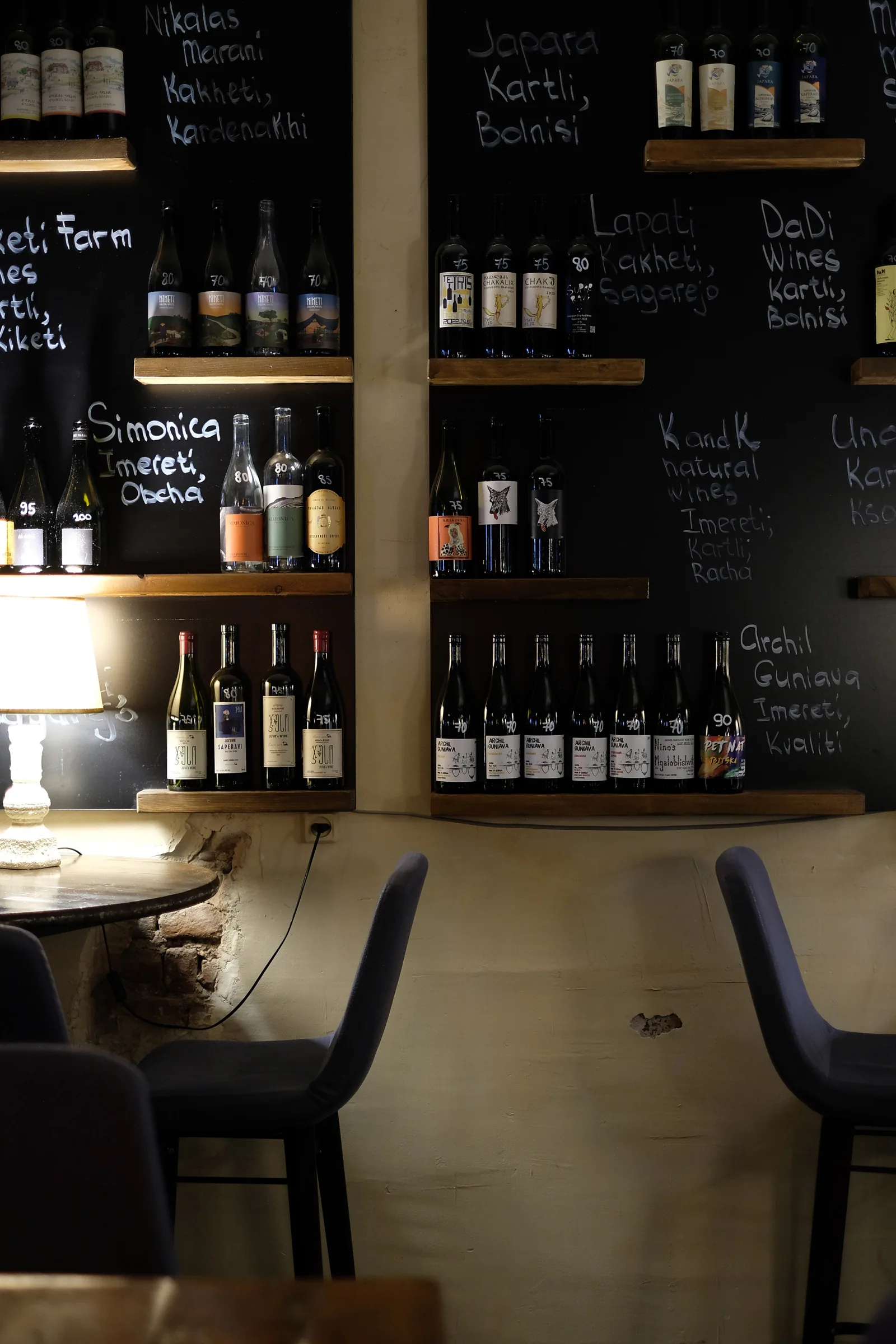
Taste alone cannot run a bar. MIDI has to make room for people who arrive wanting amber wine because that is what they believe Georgian wine should be, or for the semi-sweet styles familiar to visitors from Russia, Belarus and Ukraine, who ask for Khvanchkara and Kindzmarauli. She keeps two such wines, one white and one red, and says plainly that the rent has to be paid. The range carries her preferences without pretending that everyone entering the bar already shares them.
Sasha sat with us and followed every turn of a conversation that lasted more than two hours. At the same time, she seemed to know what was happening at the other tables, what the staff needed and which bottle had to come next. She got up, came back, answered someone, found a wine, checked her phone, continued a story from the place where she had left it. Her attention was never fixed, but neither did it feel divided. She appeared able to place it in several parts of the bar at once and be genuinely present in all of them.
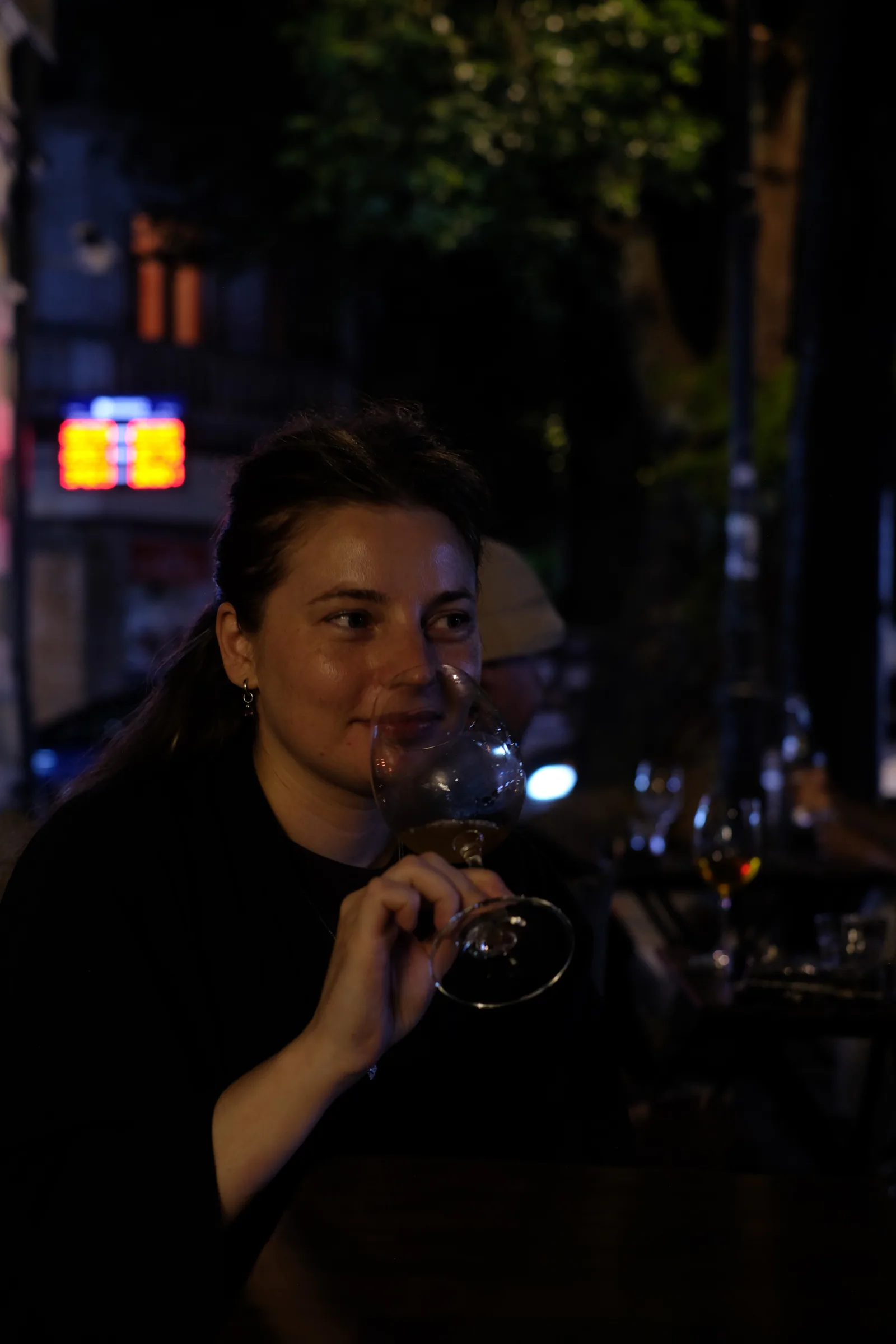
MIDI was built for that movement. Inside, Sasha installed a large communal table. She can sit there to work while people she knows arrive separately, then tell them to speak to one another while she gets on with whatever has to be done. People meet there and become friends. Many of her regulars moved to Georgia from elsewhere; others find her through Raisin and keep coming back. What they need is exactly this: a place where returning alone does not mean remaining alone.
The cultural programme began from a similarly personal need. Tbilisi had offered her painters, writers, politicians and people who wanted to talk about philosophy over a glass. Batumi was smaller, rainier and quieter for much of the year. Sasha liked her bar, its candles and its atmosphere, and did not want to leave it in search of the conversations she missed. She invited a friend who leads architectural walks through the city to give a weekly lecture. A larger organisation found the programme and proposed a collaboration, bringing talks on art, architecture and literature. She organised it, she says, first of all for herself.
Movement in the other direction is harder. Sasha travels on a Russian passport and has not been back to Russia in years. Her first visit to Europe was last November, ten days in Paris, for her birthday. Paris disappointed her in a specific way. She found bars where a queue formed at the door, where one person served a full room, where the wine arrived and the conversation did not. At the end of the night, when we thanked her for spending two hours telling us about other people’s lives, she answered:
“It’s a pleasure, because in Paris nobody told me about their lives.”
Sasha says Georgians should represent their own country. Yet MIDI is deliberately international. Its tables bring together Georgians, Russians, Ukrainians, Belarusians and visitors from elsewhere in Europe, and she has had to tell the occasional customer that this is not going to change. When women working in Tbilisi wine bars come to Batumi, Sasha invites them on her trips to Imereti, puts them in the car and asks for nothing towards the fuel. Come, she tells them. Everything is included. Her answer to a question about who has the right to represent the country is the practical work of connecting more people to it.
A Kisi from Juso’s Winery, in Sagarejo, made by the brothers Lasha and Giorgi Khvedelidze under the name of their grandfather. Sasha first met the wine and not the man: a sommelier was tasting it at her father’s bar and would not stop talking about it, so she took the winemaker’s number and ordered two boxes to see how her customers would react. They reacted. She ordered by telephone for two years. She met Lasha in person only last February, at the first wine fair held in Batumi, and she met him because Father Gabriel brought them together, telling Lasha that the woman who had been selling his wine ought to be introduced to him.
Then Gabriel’s Saperavi. Gabriel is an Orthodox monk who spent twenty-seven years at Shio-Mgvime, where he learned to make wine and cheese and became a blacksmith, and who now makes wine in Kvemo Kartli. When we first came across his photograph the combination seemed almost too good. He is real, Sasha assured us. More than that, he is her friend, prays for her every day and comes to MIDI when she needs support.
Near the end of the night, Sasha said she was fortunate to have a good team at MIDI. It gives her more time to visit wineries, taste grapes, investigate, and help producers. Some now ask which wines she would prefer to sell, or what she thinks about skin contact. She did not describe this as authority. The point was reciprocal support: sharing knowledge, helping guests understand what happens in the cellar, putting people in contact.
Her father remained present throughout the conversation, even before we knew him. He was the one who brought her to Georgia, called her out of the kitchen and took her to the wineries. He co-owns DADI, the wine bar in Tbilisi whose name is cut from the street on which it stands, and, in Sasha’s joking description, he is also her distributor, driving bottles across the country to Batumi.
Later, when we reached Tbilisi, we were able to spend three days tasting with him. There were more than ten wines on the first night at DADI alone. He also took us to Tanini Wines and to Kiketi Farm. Over those days Tanini’s Kisi became the bottle to which we returned most often. He loved its peach notes. What Sasha had told us at MIDI became recognisable almost immediately: the immense generosity, the instinct to bring people and wines together, the pleasure he took in sharing stories about Georgia and about his own life. He has a very particular humour, the kind that changes the rhythm of the days and makes time with him feel unlike a formal visit. It was also clear how proud he is of what Sasha has built for herself. We loved meeting him. Father and daughter are different people, with different ways of occupying a room, but they share the same unusual generosity. The help she had given us before we arrived no longer seemed to come from nowhere. Both have the same habit of making room for people, then taking them further than they had asked to go.
“I would like to be the bridge between guests and the wineries.”
We told her she already was. Our route through Imereti had begun in her Instagram messages and continued from one person to the next, a constellation of contacts held together by trust. Even as we sat in front of her, Sasha kept extending it. The weather was still warm. Around us, the bar carried on, and so did she: pouring, listening, watching, remembering another person we should yet meet.